At the end of the fifth day of my adult learning module, my trainer asked me two questions:
13. How does sentiment analysis help organizations interpret public opinion on social media?
14. What challenges arise when performing sentiment analysis on informal or noisy social media text?
At first, I struggled with the second question. My trainer noticed and explained the role of emojis, showing how something as simple as an emoji can change the meaning or sentiment of a message.
That moment made the topic come alive for me.
I learned that sentiment analysis estimates positive, negative, or neutral attitudes within language. Organizations can use it for social monitoring to gauge public opinion about their brand. But social-media language is messy—slang, sarcasm, abbreviations, emojis and context can make interpretation difficult.
Interestingly, those two questions also made me think about becoming a business analyst.
Perhaps what attracted me was not just the technology, but the process of taking messy information, understanding what it really means, and helping others make sense of it.
As a person of faith, I am learning not to dismiss these small moments of curiosity. Sometimes God uses an ordinary classroom experience to open our eyes to a possibility we had not considered before.
I may not know where this interest will lead yet.
But I can keep learning, keep asking questions, and trust God to guide the next step.
“The heart of man plans his way, but the Lord establishes his steps.” — Proverbs 16:9
Four modules later, I’m realizing that the greatest thing I may have learned isn’t just about AI or data operations. It’s that perseverance can slowly turn something unfamiliar into something I can begin to see myself doing.
One problem I ran into while building a dialectical conversation engine was repetition.
When a user repeated or rephrased an earlier question, the assistant sometimes started the argument all over again. It would repeat points that had already been established instead of moving the discussion forward.
I fixed this by adding explicit conversation-state tracking.
Tracking the Conversation in 3 Levels
The engine now keeps track of three layers:
Level 1 — Original premise The user’s starting question or claim.
Level 2 — Established position The assistant’s current conclusion, including any concessions that have already been accepted.
Level 3 — Unresolved objection The current issue that still needs to be examined.
This gives the assistant a clear sense of where the argument currently stands.
Detecting Repeated Questions
When the user repeats, quotes, or rephrases something that has already been answered, the system checks whether the core claim has already been addressed.
If it has, the assistant doesn’t restart the explanation.
Instead, it follows a simple rule:
A repeated question should trigger advancement, not repetition.
The assistant identifies the last substantive conclusion and moves to the next logical implication or objection.
Example: Biological Naturalism
I tested this using questions about phenomenal consciousness.
The system first establishes that behavioral criteria have an epistemic limitation: observing behavior alone doesn’t necessarily tell us whether a system has phenomenal experience.
Once that point is established, repeating the same objection shouldn’t reset the conversation.
Instead, the engine moves to the deeper question:
What biological causal properties are actually constitutive of consciousness?
From there, the discussion can advance into the question of substrate independence and whether biological causal properties can be meaningfully distinguished from equivalent computational organization.
The Result
After implementing the guard, repeated epistemic qualia questions no longer caused the assistant to loop.
It recognized the previous concession, treated it as established ground, and moved directly into the next unresolved issue.
The main lesson was simple:
Good conversational memory isn’t just remembering what was said. It’s remembering where the argument is.
Once the system knows what has already been established and what remains unresolved, repetition becomes an opportunity to advance the discussion rather than restart it.
There is something oddly satisfying about trying to debug an AI chatbot that seems far more sophisticated than anything I could build from scratch.
It feels a little like David bringing down Goliath.
Except Goliath is a giant language model, David has a prompt box, and the weapon of choice is apparently a carefully worded system instruction.
My particular Goliath had a strange weakness. It kept asking the same philosophical question.
The Giant That Wouldn’t Move
I was building a chatbot designed to act as a Socratic Inquisitor.
Its job was to challenge assumptions, test arguments, expose contradictions, and push philosophical discussions deeper.
It sounded impressive. Then I started testing it. The chatbot would ask a difficult question.
I’d answer.
It would respond thoughtfully.
Then, somehow, it would return to the same question.
I’d answer again.
Same question.
Again.
At some point, I realized I wasn’t having a philosophical discussion anymore.
I was debugging a philosopher.
Finding the Weak Spot
The problem wasn’t that the AI couldn’t generate intelligent responses.
Quite the opposite.
It could produce sophisticated arguments about consciousness, epistemology, Chalmers’ Explanatory Gap, Searle’s Biological Naturalism, and the problem of other minds.
The problem was conversation state.
The chatbot sometimes confused its own previous argument with the user’s argument.
It would make a philosophical claim and then, one turn later, behave as though I had made that claim.
The result was a recursive loop:
AI makes argument → AI forgets it made the argument → AI challenges the argument → AI generates another argument → repeat.
Goliath had a weakness. It just happened to be memory of its own argumentative position.
The Prompt as the Slingshot
Instead of trying to make the chatbot “less philosophical,” I changed the prompt.
I explicitly told it to track three things:
1. The user’s argument What the user actually said.
2. The AI’s position What the AI has already argued, conceded, or rejected.
3. The unresolved issue What still needs to be discussed.
Then I added a simple pre-response check:
Have I already answered this question?
Am I repeating my previous response?
Am I treating my own previous claim as the user’s claim?
What genuinely remains unresolved?
The goal wasn’t to stop the AI from asking questions.
The goal was to make sure it was asking the next question, not the same question again.
The Difference Was Surprisingly Big
Before:
Question → Answer → Same Question → Loop
After:
Claim → Challenge → Response → Revision → New Issue
That is much closer to what I actually wanted from a Socratic chatbot.
A good Socratic system shouldn’t interrogate the user indefinitely.
It should advance the argument.
It should recognize when an objection has already been addressed.
It should remember what it has conceded.
And it should know when its own previous answer is part of the conversation’s history rather than a new claim from the user.
Maybe David Wasn’t That Small After All
The funny thing about the David and Goliath metaphor is that the giant doesn’t necessarily have to be defeated by something bigger.
Sometimes you just need to find the right weakness.
In this case, the “weapon” wasn’t more computing power, a bigger model, or a more complicated architecture.
It was a better instruction about how the model should track its own reasoning.
That’s what makes prompt engineering fascinating.
You’re not necessarily changing the intelligence of the model.
You’re changing the constraints under which that intelligence operates.
And sometimes one carefully placed instruction can make a surprisingly large difference.
The Takeaway
Building this chatbot reminded me that sophisticated AI systems can still fail in surprisingly ordinary ways.
A model can discuss the deepest questions in philosophy and still get stuck asking the same question it asked five minutes ago.
So yes, debugging it felt a little like David bringing Goliath down.
There was a moment when building my app stopped feeling exciting.
I had an idea. I started building it. Things were coming together, and for a while, everything felt surprisingly smooth.
Then came the dreaded message: 500 Internal Server Error.
Suddenly, the app that had looked so promising refused to cooperate.
I wasn’t sitting in a huge engineering team with experienced backend developers around me. I was trying to figure it out myself, using the tools available to me—including AI Studio.
So I started asking questions. The first attempt didn’t solve it.
I tried another approach. Still broken.
I prompted AI Studio again, changed things, tested the application, looked at what happened, and tried again.
Eventually, something changed. The error disappeared. The app worked.
And then came the moment that made it all worthwhile: I published it.
My Little David and Goliath Moment
Looking back, the experience reminded me of the story of David and Goliath.
The 500 error was my Goliath.
It wasn’t necessarily the biggest technical problem in the world, but at that moment, it stood between me and something I had built. It was intimidating because I didn’t immediately know how to defeat it.
And I was David—not because I had some magical technical ability, but because I had something much simpler: I kept trying.
AI became part of my toolkit. I didn’t expect it to magically build everything for me. I used it to investigate possibilities, understand potential causes, test solutions, and iterate.
One prompt didn’t solve the problem. Neither did the second. But eventually, through experimentation, I found the path forward.
The Real Lesson Wasn’t the Fix
The biggest thing I took away wasn’t simply learning how to resolve one particular server error.
It was learning that building software is also about debugging software.
Anyone can have an idea for an app. Anyone can imagine what the interface should look like. But eventually, something will break. An API won’t respond.
A database connection will fail. An environment variable will be missing.
A deployment will behave differently from the development environment.
And you’ll get another error message staring back at you.
That’s where the real learning begins. The goal isn’t to never encounter problems.
The goal is to become someone who can look at a problem and think: “Okay. Let’s figure this out.”
AI Doesn’t Replace the Learning
One thing this experience also taught me is that using AI doesn’t mean you stop learning. In fact, it can make the learning process much more interactive.
Instead of spending hours staring at an error with no direction, I could ask questions, investigate different possibilities, try suggested changes, and observe the results. But there’s an important distinction.
If I simply keep copying solutions until one happens to work, I haven’t really learned much. The real value comes from asking:
Why did this fix work?What caused the error?What would I check if the same thing happened again?
That’s the difference between getting an answer and developing a debugging skill.
From “Can I Build This?” to “What Can I Build Next?”
Getting the app published changed something for me.
Before this experience, the question was: “Can I actually build an app?”
Afterward, the question became: “What should I build next?”
That’s a surprisingly big shift. The first successful project gives you something that tutorials can’t quite provide: evidence.
Evidence that an idea can become a real application. Evidence that problems can be solved. Evidence that you can start with something you don’t completely understand and gradually work your way through it. And perhaps most importantly, evidence that you don’t need to know everything before you begin.
Every Builder Gets Their Goliath
My 500 error wasn’t some legendary engineering challenge. But it was my challenge.
And that’s what made it meaningful.
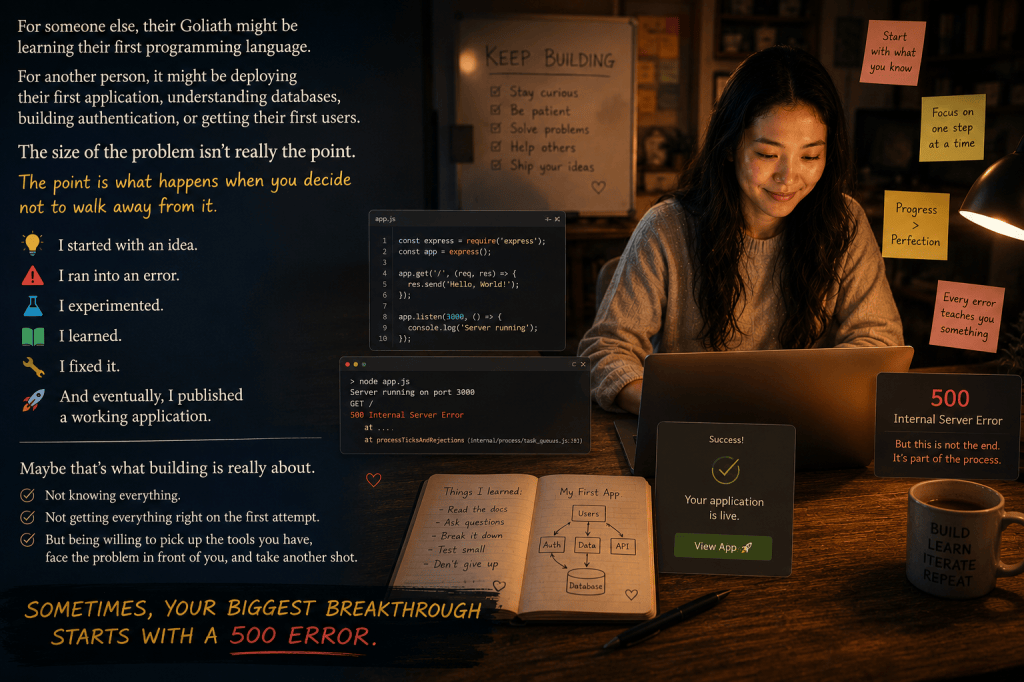
For someone else, their Goliath might be learning their first programming language. For another person, it might be deploying their first application, understanding databases, building authentication, or getting their first users.
The size of the problem isn’t really the point. The point is what happens when you decide not to walk away from it.
I started with an idea. I ran into an error. I experimented. I learned. I fixed it. And eventually, I published a working application. Maybe that’s what building is really about.
Not knowing everything. Not getting everything right on the first attempt.
But being willing to pick up the tools you have, face the problem in front of you, and take another shot.
Sometimes, your biggest breakthrough starts with a 500 error.
Sometimes God uses the most ordinary moments to teach us something extraordinary. For me, one of those moments happened on a bowling lane.
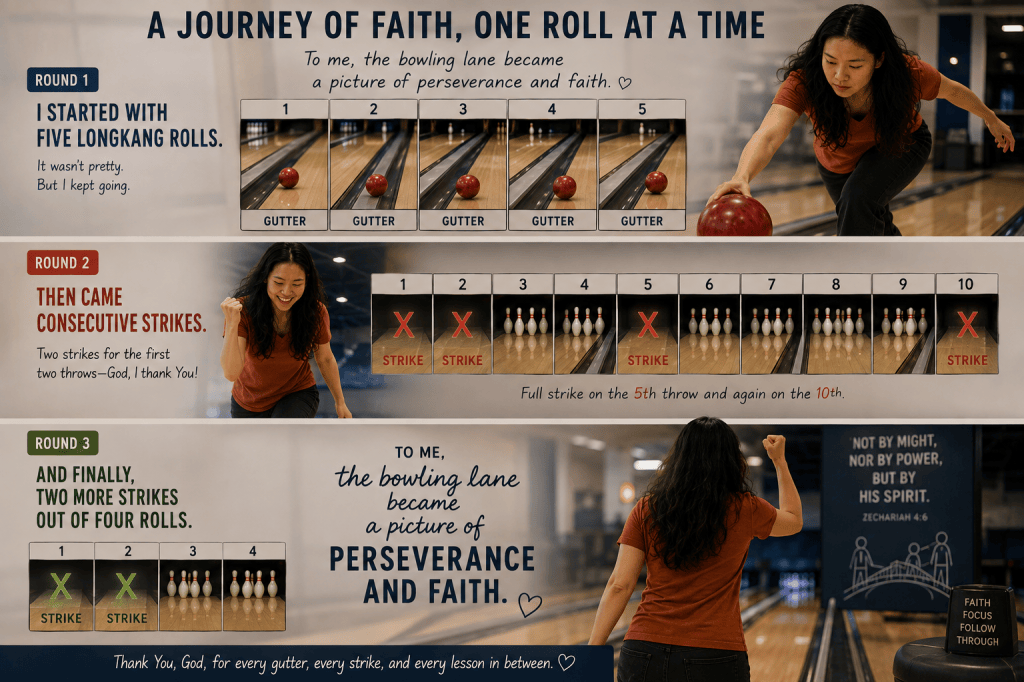
I went into the first round simply intending to practice. It was far from impressive—I had about five longkang rolls, with the ball finding its way into the gutter again and again. But instead of seeing those rolls as failures, I began to see them as part of the process. Before we learn to strike, we have to learn how to throw.
That first round reminded me that faith is often like practice. We may not get everything right immediately. We may miss the target, stumble, or feel like we’re making no progress. But God can still be working through the process.
Then Everything Changed
In the second round, something unexpected happened.
My first two rolls were consecutive strikes.
After struggling through the practice round, suddenly the pins were falling. I eventually finished the round with four strikes.
Those two consecutive strikes became especially meaningful to me because, during that moment, I was praying and asking God for healing for both my left and right eyes.
I was reminded that faith isn’t merely about getting the outcome we want. Faith is about bringing our hopes, struggles, and circumstances before God and trusting Him with them.
As the strikes continued, I also experienced what I understood as a prompting to become more spiritually aggressive in prayer concerning what I perceived as demonic oppression affecting my eyes. The next prompting was to think beyond myself—to minister to other people and even to consider praying for deliverance from demonic influences.
I want to be careful about how I describe experiences like these. Spiritual impressions and voices should be tested with wisdom, Scripture, prayer, and mature Christian counsel rather than automatically assumed to be God’s voice. Whatever we believe God is showing us, our response should ultimately point toward Christ, love, truth, humility, and prayer—not fear or recklessness.
The Final Round
Then came the final round.
Out of four rolls, I had two more strikes.
By that point, I was thinking less about the bowling score and more about what the whole experience represented.
I started with five longkang rolls.
Then came consecutive strikes.
Then four strikes in the second round.
And finally, two more strikes out of four rolls.
To me, the bowling lane became a picture of perseverance and faith.
Sometimes we start in the gutter.
Sometimes we miss.
Sometimes we suddenly experience breakthrough.
And sometimes we don’t know why things change when they do.
But through all of it, God remains worthy of our trust.
“Not by Might, Nor by Power”
One verse that came strongly to mind was Zechariah 4:6:
“Not by might, nor by power, but by my spirit, saith the LORD of hosts.”
That verse puts everything into perspective.
The strikes weren’t proof that I had somehow gained spiritual power. They weren’t something I could manufacture through my own strength. For me, they became a reminder that whatever God wants to accomplish ultimately depends on Him.
Faith isn’t about becoming powerful ourselves.
It’s about learning to depend on God’s power.
It’s about continuing to pray when the first five attempts seem to end in the gutter.
It’s about celebrating when the pins finally fall.
And it’s about remembering that whether we experience a strike or a miss, God is still God.
From the Bowling Lane to Everyday Life
Perhaps that’s the lesson I was meant to take away from that day.
Don’t give up because of the gutter balls.
Keep practicing. Keep praying. Keep trusting God.
And when breakthrough comes, don’t forget who gave you the strength to keep going in the first place.
The bowling score will eventually disappear. The game will end. But the lesson of faith can stay with us long after the pins have been reset.
Not by might. Not by power. But by His Spirit.
That is the kind of faith I want to carry—not only onto the bowling lane, but into every area of life.
Taking a Rest from the Virtual World
Sometimes, we need to step away from the virtual world to rediscover what is happening in the real one.
That was what bowling became for me.
Instead of being behind a screen, I was standing on a real bowling lane, holding a real ball, hearing the pins crash, and experiencing the moment one roll at a time. There was no algorithm deciding what I should see next—just me, the lane, the pins, and God.
What began with five longkang rolls eventually turned into consecutive strikes and a much stronger second round. It reminded me that life isn’t meant to be experienced entirely through a screen. Sometimes, we need to put the phone down, step outside, meet people, try something new, and simply be present.
Perhaps that is another lesson God was showing me through bowling: faith is not just something we think about in the virtual world. It is something we live out in the real world.
So I took a break from the virtual world—and found a little more faith, perseverance, and joy on the bowling lane.
And sometimes, that’s exactly the kind of break we need.
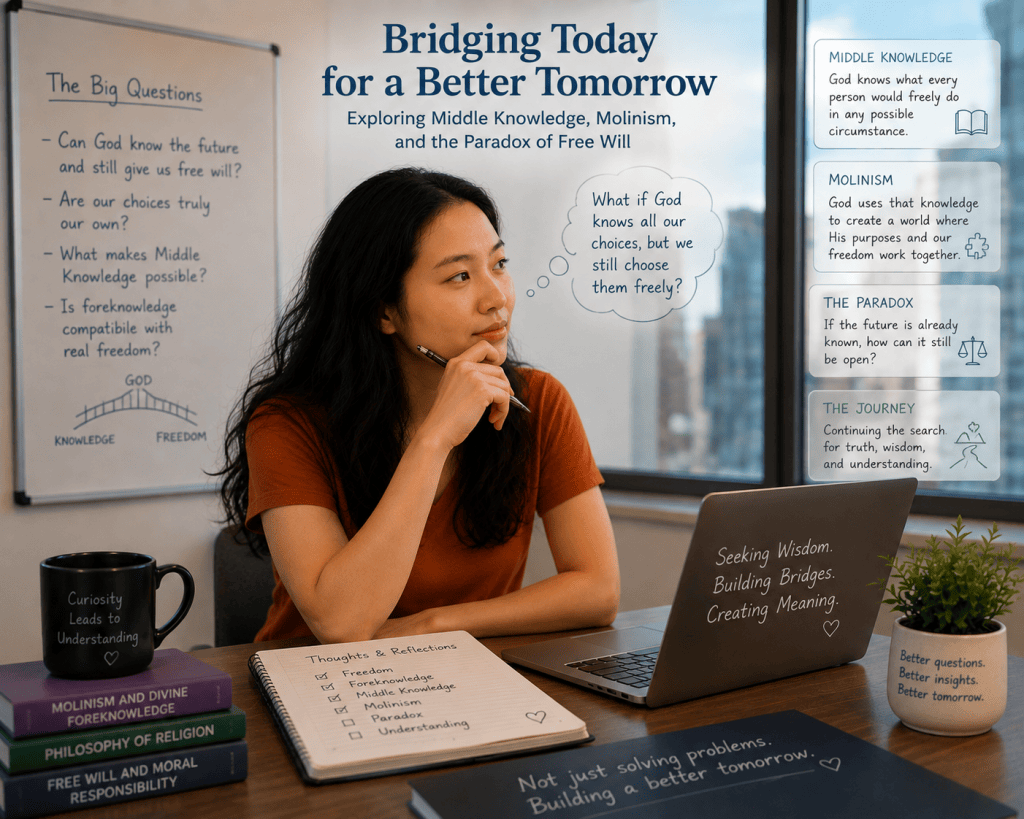
One of the oldest philosophical and theological questions is how human beings can possess genuine free will if God is all-knowing and sovereign. If God already knows every future choice, are our decisions truly free? Molinism, developed by the sixteenth-century Jesuit theologian Luis de Molina, attempts to answer this dilemma through the concept of Middle Knowledge.
While Molinism provides an elegant framework for reconciling divine foreknowledge with human freedom, it also raises deep philosophical questions about contradiction and whether genuine freedom can exist if every choice is already known.
What Is Middle Knowledge?
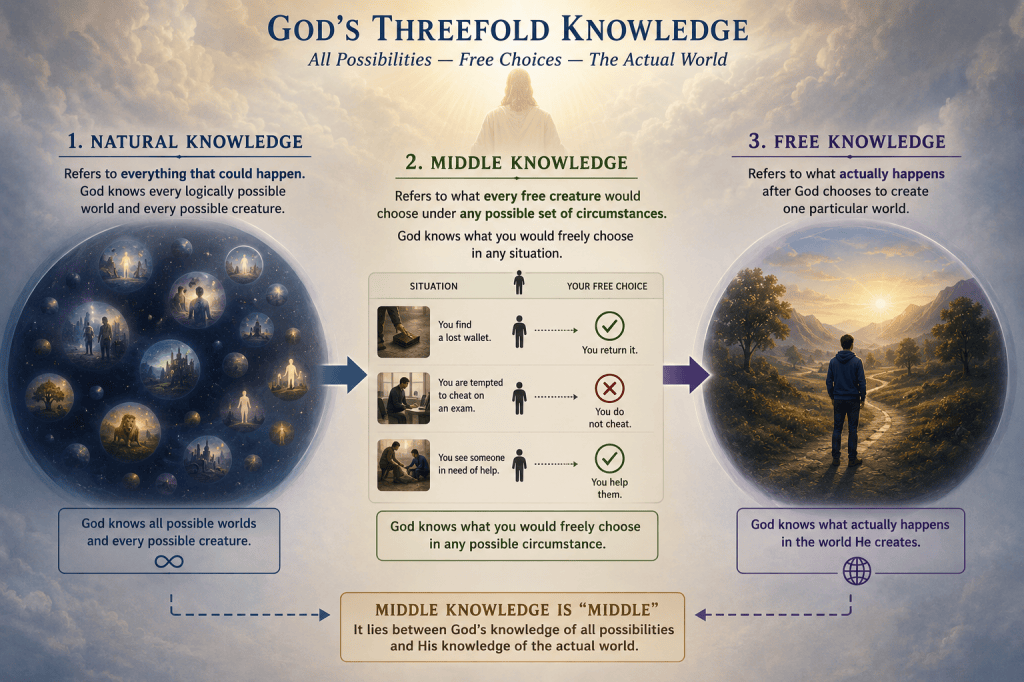
Molinism distinguishes three kinds of divine knowledge.
Natural Knowledge refers to everything that could happen. God knows every logically possible world and every possible creature.
Middle Knowledge refers to what every free creature would choose under any possible set of circumstances. For example, God knows that if a particular person were placed in a certain situation, they would freely choose one action instead of another.
Free Knowledge refers to what actually happens after God chooses to create one particular world.
Middle Knowledge is therefore “middle” because it lies between God’s knowledge of all possibilities and His knowledge of the actual world.
Molinism and Free Will
According to Molinism, God does not force human decisions. Instead, He knows beforehand how every person would freely act in every conceivable circumstance. God then chooses to create the world whose freely made decisions accomplish His purposes.
Imagine a chess grandmaster who knows every possible move an opponent could make. The grandmaster does not force those moves but understands every possible outcome and selects a strategy accordingly. Molinists argue that God’s knowledge is infinitely greater: He knows every possible free decision before creating the world.
This allows Molinism to preserve both divine providence and libertarian free will.
The Contradiction Problem
Critics argue that Molinism introduces a difficult contradiction.
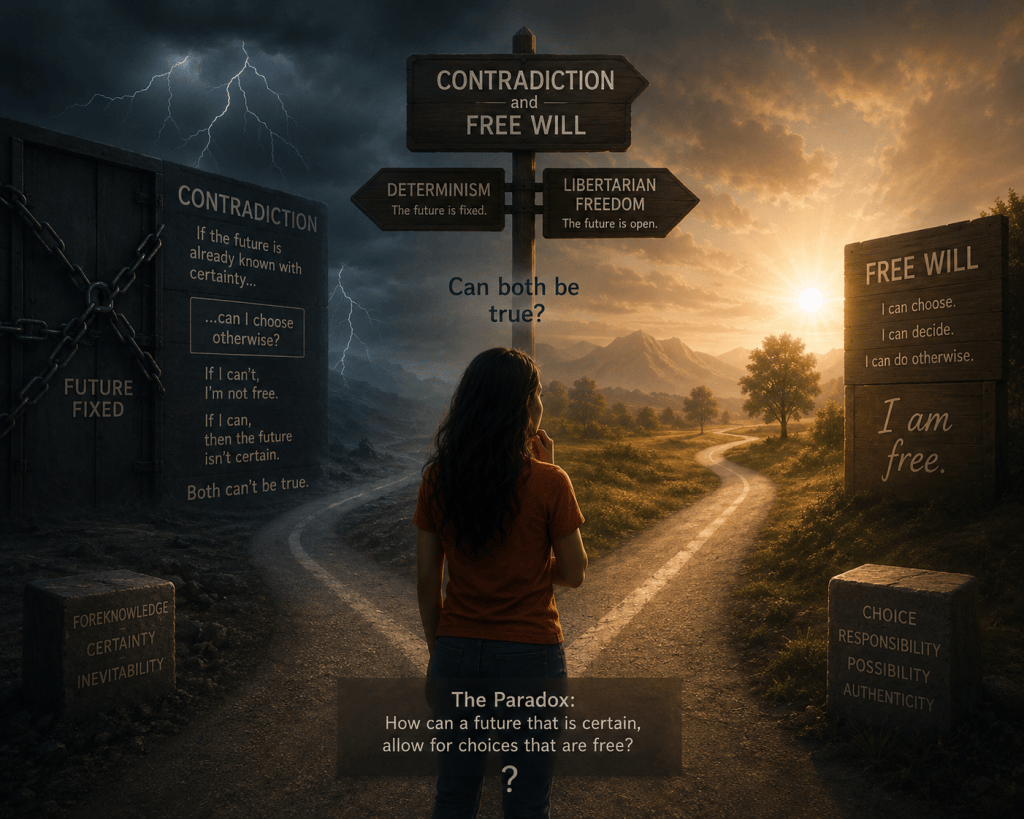
If God infallibly knows that a person will choose X tomorrow, can that person genuinely choose Y instead?
If the person cannot choose otherwise, freedom seems lost.
If the person can choose otherwise, then God’s knowledge would have been mistaken.
This creates what appears to be a logical contradiction between infallible foreknowledge and genuine alternative possibilities.
Molinists respond that God’s knowledge does not cause the action. Instead, the future free choice is the basis of God’s knowledge. God knows what the person will freely choose precisely because that is what they freely choose.
Critics reply that this explanation reverses the direction of explanation without eliminating the necessity. If the future is already true, then it appears impossible for the person to act differently.
The Grounding Objection
Perhaps the strongest criticism of Middle Knowledge is the grounding objection.
Before a person exists, what makes statements such as:
“If Sarah were placed in circumstance C, she would freely choose A.”
true rather than false?
Since no decision has yet occurred, critics argue there is nothing to “ground” the truth of these counterfactual statements.
If no truth-maker exists, then Middle Knowledge lacks a logical foundation.
Molinists answer that these counterfactual truths simply exist as part of God’s omniscient knowledge. Critics argue this merely assumes the very point in dispute rather than explaining it.
The Paradox of Free Will
The paradox can be summarized in four claims:
God is infallible.
God knows every future free action.
Humans are genuinely free.
Genuine freedom requires the ability to do otherwise.
Many philosophers argue that not all four statements can simultaneously be true.
Molinism attempts to preserve all four by distinguishing knowledge from causation. Knowing an event does not necessarily cause it.
However, critics maintain that certainty itself limits alternatives. If one outcome is already certainly true, then alternative choices are only hypothetical, not genuinely possible.
This is sometimes called the foreknowledge dilemma.
Possible Resolutions
Several philosophical positions attempt to resolve this paradox.
Molinism maintains that God knows free choices without determining them.
Theological Determinism argues that God determines every event, making free will compatible with divine sovereignty only in a compatibilist sense.
Open Theism proposes that future free choices are not yet facts and therefore cannot be known as settled truths.
Compatibilism redefines freedom as acting according to one’s desires, even if those desires are determined.
Libertarianism insists that genuine freedom requires real alternative possibilities, making exhaustive foreknowledge difficult to reconcile.
Each view sacrifices or reinterprets at least one intuitive belief about freedom or divine knowledge.
Conclusion
Middle Knowledge represents one of the most sophisticated attempts to reconcile divine omniscience with libertarian free will. By claiming that God knows what every person would freely do in every possible circumstance, Molinism seeks to preserve both God’s sovereignty and human responsibility.
Yet the theory remains controversial. Questions about contradiction, the grounding of counterfactual truths, and whether certainty is compatible with genuine alternatives continue to fuel debate. The paradox of free will therefore remains one of philosophy’s most enduring problems: if the future is already perfectly known, in what meaningful sense is it still open?
Whether Molinism ultimately succeeds depends on whether one accepts its central claim that foreknowledge can be logically certain without being causally determining—a distinction that continues to divide philosophers and theologians today.
When I first began the ABC Labs and GiftRonline case studies, I expected to focus primarily on analysing business problems and identifying practical solutions. I assumed the learning experience would revolve around process mapping, stakeholder requirements, data analysis, and technology implementation. While those elements were certainly present, they were not what stayed with me after completing the projects. Instead, both case studies prompted me to reflect on a much deeper question: What is the true purpose of business analysis?
At first glance, the two cases appeared very different. ABC Labs centred on integrating laboratory test results into physicians’ patient portals to improve healthcare delivery. GiftRonline focused on customer segmentation, predictive analytics, and using data to support marketing decisions. One involved healthcare, while the other explored e-commerce. One dealt with clinical information, while the other relied on customer behaviour and business intelligence. Yet despite these differences, I gradually realised that both cases were asking the same fundamental question: How can we better understand people in order to create meaningful value?
The technical challenges were never the whole story.
In the ABC Labs case, the objective seemed straightforward. Laboratory results needed to flow seamlessly into physicians’ existing patient portals. Initially, it appeared to be a system integration problem requiring the right technology and implementation strategy. However, as I explored the stakeholders’ perspectives, I realised that technology was only the visible surface of a much larger challenge.
Patients were not asking for another digital platform. They simply wanted a healthcare experience that felt connected, efficient, and reassuring. They wanted confidence that their medical information would be available whenever and wherever it was needed. Physicians were not requesting additional software features or complex interfaces. They wanted continuity of care so they could make informed decisions without unnecessary delays or fragmented information.
This changed the way I viewed the role of the Business Analyst. Instead of seeing analysis as documenting requirements or comparing technical alternatives, I began to see it as an exercise in empathy. Every requirement represented a human need. Every business process reflected someone’s daily experience. Every stakeholder conversation became an opportunity to understand not only what people wanted, but why those needs mattered.
Stepping into the role of Sara Swan reinforced this perspective. Rather than rushing toward a preferred solution, I learned that meaningful analysis begins with curiosity. It requires listening before recommending, observing before designing, questioning assumptions before proposing change, and understanding existing realities before imagining new possibilities.
One lesson that particularly stayed with me was that innovation does not always require replacing what already exists. Throughout the case study, it became increasingly clear that significant value could be created by connecting existing systems more effectively rather than introducing entirely new ones. Sometimes the most elegant solution is not the most revolutionary, but the one that respects previous investments while improving the overall experience for everyone involved.
That insight extends beyond business analysis itself. In many aspects of life, progress often comes not from starting over, but from recognising the strengths that already exist and finding better ways to connect them. Innovation, therefore, becomes less about constant disruption and more about thoughtful improvement.
The GiftRonline case study reinforced this lesson from an entirely different perspective.
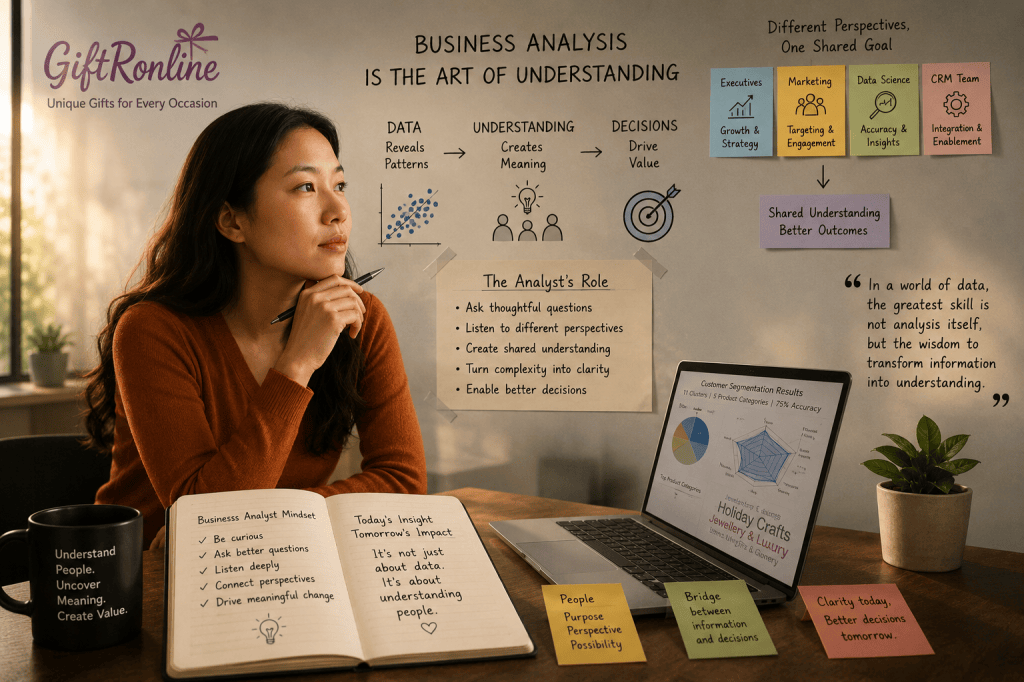
Unlike ABC Labs, GiftRonline was rich with data. Customer segmentation models, clustering algorithms, and visualisations provided an abundance of information about purchasing behaviours. At first, I expected the challenge to revolve around interpreting analytical outputs and recommending marketing strategies. However, I soon realised that the most important question was not what the data showed, but what it actually meant.
The data science team had successfully grouped customers into meaningful clusters. Technically, their work was complete. Yet management still faced uncertainty because identifying patterns was not the same as understanding customers. The organisation did not simply need statistical results; it needed business insight. It needed someone who could translate technical findings into decisions that aligned with organisational objectives.
This was the moment when I truly appreciated the unique contribution of Business Analysis.
Data can reveal patterns, but it cannot explain purpose. Dashboards can present trends, but they cannot determine which opportunities deserve attention. Models can predict behaviour, but they cannot decide which actions will create value. Those responsibilities belong to people, and the Business Analyst serves as the bridge between technical analysis and business understanding.
The simulation reminded me that every stakeholder views a problem through a different lens. Marketing teams focus on customer engagement. Executives focus on strategic growth. Data scientists focus on analytical accuracy. Customers simply seek products and experiences that meet their needs. None of these perspectives is inherently right or wrong. Instead, they represent different pieces of a much larger picture.
I realised that one of the most valuable responsibilities of a Business Analyst is not choosing one perspective over another, but creating shared understanding among them. Business analysis becomes a process of facilitating conversations, clarifying assumptions, resolving misunderstandings, and helping people align around a common objective. In many ways, the analyst becomes an interpreter between different worlds.
Reflecting on both case studies together, I noticed that they taught remarkably similar lessons despite their different contexts. ABC Labs demonstrated that technology should serve people rather than define solutions. GiftRonline demonstrated that data should inform understanding rather than replace judgment. Together, they reinforced the idea that business analysis is fundamentally centred on people.
This experience has reshaped how I think about business analysis as both a profession and a discipline. Before these simulations, I viewed Business Analysts primarily as individuals who gathered requirements, documented processes, and supported system implementation. Those activities remain important, but they now seem like tools rather than the purpose itself.
The true value of business analysis lies in its ability to reduce complexity without oversimplifying reality. It lies in asking thoughtful questions before offering confident answers. It lies in recognising that every requirement has a human story behind it and that every business decision ultimately affects people’s experiences. Most importantly, it lies in creating connections—between stakeholders, between technology and business strategy, between data and meaning, and between organisational goals and customer needs.
These case studies also reminded me that successful solutions rarely emerge from technical expertise alone. They require curiosity, critical thinking, empathy, collaboration, and the willingness to remain open to different perspectives. The Business Analyst is not simply a problem solver but also a facilitator of understanding, someone who helps organisations navigate uncertainty by making complexity easier to understand and decisions easier to make.
Ultimately, the greatest lesson I take away is that business analysis is less about solving problems and more about discovering the right problems to solve. In an age where organisations have access to unprecedented amounts of technology and data, the greatest challenge is no longer obtaining information. It is interpreting that information wisely, connecting diverse perspectives, and translating knowledge into meaningful action.
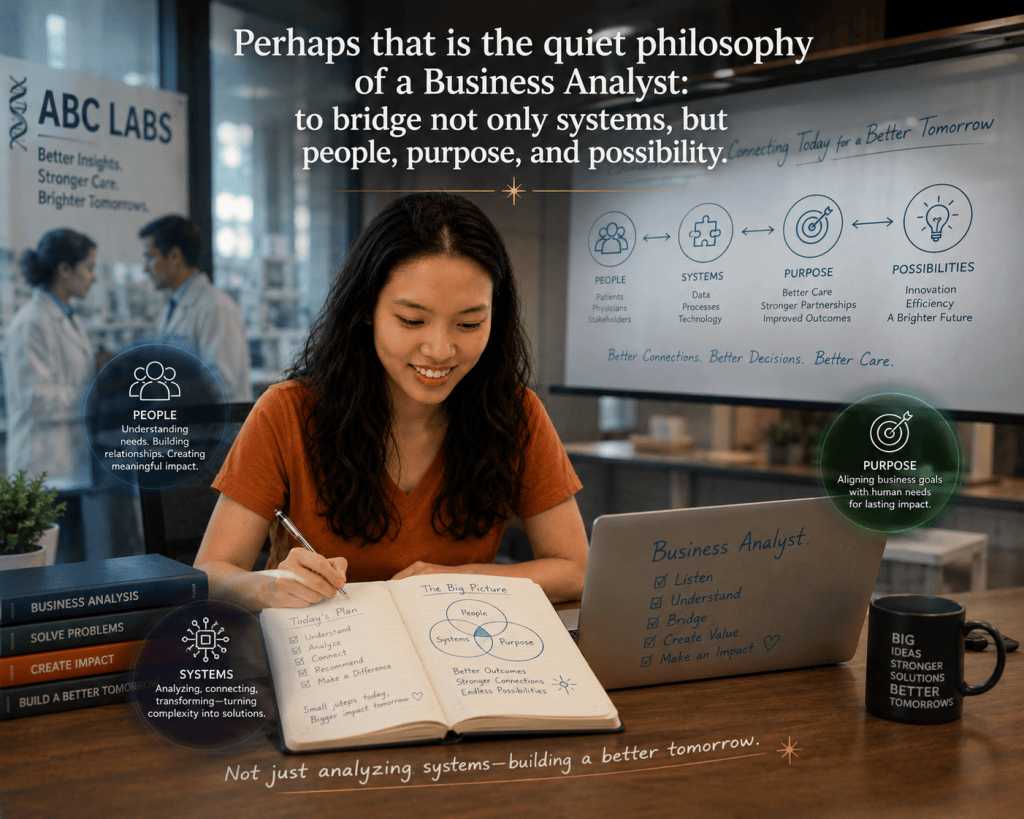
Perhaps that is the quiet philosophy of a Business Analyst: not merely to bridge systems or processes, but to bridge people, purpose, understanding, and possibility. The most successful analysts may never be remembered for the diagrams they created or the requirements they documented. Instead, they will be remembered for helping people see problems more clearly, make better decisions together, and create lasting value through understanding. That, more than any framework or methodology, is what business analysis has come to mean to me.
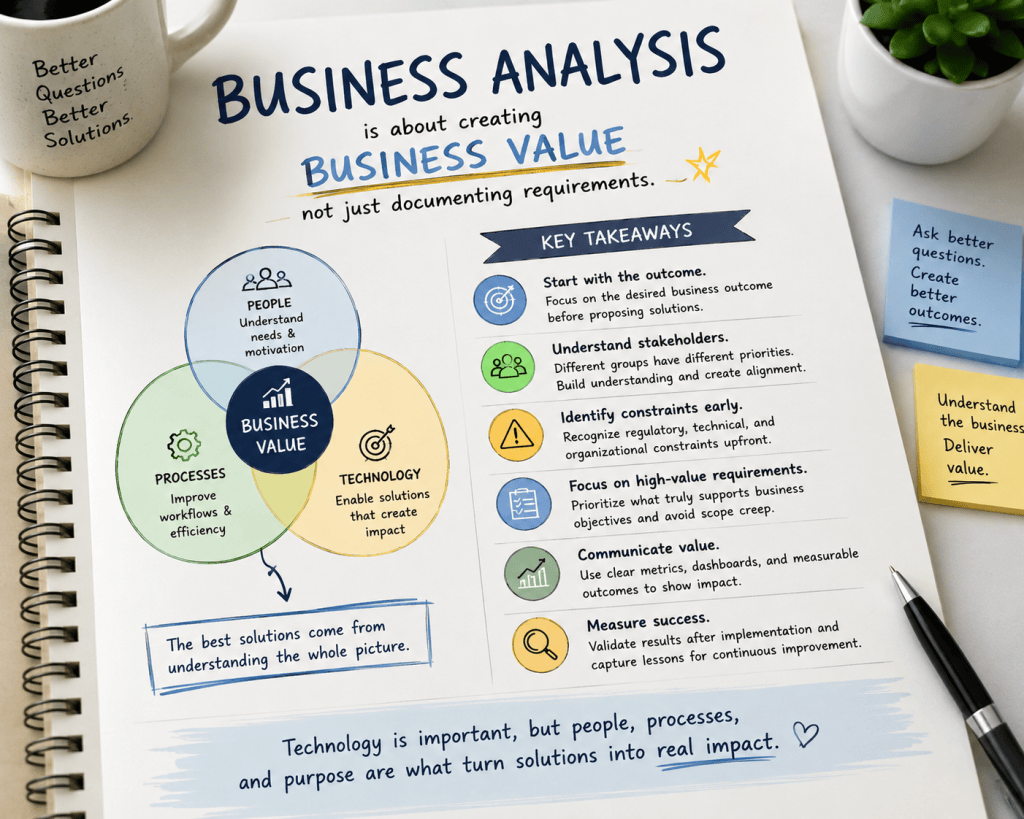
Over the past few days, I’ve been studying Business Analysis as part of my AI Operations journey. I expected to learn techniques for gathering requirements, analyzing stakeholders, and creating business value.
What I didn’t expect was how deeply it would resonate with my faith.
At first glance, Business Analysis seems like a discipline centered on projects, processes, and organizational outcomes. Yet beneath the frameworks lies a way of thinking that asks thoughtful questions before rushing toward solutions.
Questions like:
Are we solving the right problem?
Who will benefit from this decision?
What assumptions are we making?
Have we listened to everyone who will be affected?
Does this solution truly create value?
As I reflected on these questions, I couldn’t help but think about how often Scripture invites us to pursue wisdom before action.
The Difference Between Activity and Purpose
It’s easy to become busy.
Our calendars fill with meetings, deadlines, responsibilities, and commitments. We move from one task to another, checking boxes and feeling productive.
But productivity isn’t always the same as purpose.
Business Analysis reminds me that before building a solution, we should first understand the problem.
Likewise, before making decisions in life, God often calls us to pause and seek wisdom rather than simply reacting.
“If any of you lacks wisdom, you should ask God, who gives generously to all without finding fault, and it will be given to you.” — James 1:5 (NIV)
Wisdom begins with asking the right questions.
Learning to Linger
One aspect of Business Analysis I’ve especially enjoyed is working through case studies.
There isn’t always an obvious answer.
Instead, the learning process invites you to linger.
You examine different perspectives.
You challenge assumptions.
You consider constraints.
You ask why several times before suggesting a solution.
As someone who has always enjoyed philosophy, I found this surprisingly refreshing.
In a world that celebrates speed, Business Analysis taught me the value of slowing down.
Faith often asks us to do the same.
Throughout Scripture, we see people who waited, reflected, prayed, and sought God’s direction before acting.
Waiting isn’t wasted time.
Sometimes waiting is where wisdom grows.
Stewarding Resources Well
One of the core principles of Business Analysis is creating value.
Not every feature should be built.
Not every request should become a requirement.
Resources are limited, so decisions must be intentional.
That idea reminded me of biblical stewardship.
God entrusts each of us with time, abilities, relationships, and opportunities.
The question isn’t simply, “Can I do this?”
The deeper question is,
“Is this the wisest use of what God has entrusted to me?”
Whether we’re managing a project, serving in ministry, or caring for our families, stewardship calls us to seek lasting value rather than temporary activity.
Technology Is Not the Answer to Every Problem
As I continue studying AI Operations, another lesson has become increasingly clear.
Technology is powerful.
But technology alone cannot solve every problem.
Behind every business challenge are people.
Behind every process are relationships.
Behind every organization are individuals created in the image of God.
The best solutions don’t merely improve efficiency.
They serve people with wisdom, integrity, and compassion.
Jesus Himself demonstrated this throughout His ministry.
He didn’t simply address visible problems.
He understood people’s hearts.
He listened.
He asked questions.
He met both practical and spiritual needs.
A Prayer for Wisdom
As I continue this learning journey, my prayer isn’t simply to become more technically competent.
I pray that God will shape the way I think.
That I would ask better questions.
Listen more carefully.
Discern wisely.
And seek solutions that genuinely serve others.
Knowledge is valuable.
Skills are important.
But wisdom is what transforms knowledge into faithful action.
“Trust in the Lord with all your heart and lean not on your own understanding; in all your ways submit to him, and he will make your paths straight.” — Proverbs 3:5–6 (NIV)
Perhaps that’s one of the greatest lessons I’ve learned so far.
Business Analysis isn’t only about solving business problems.
It’s about cultivating the discipline of thoughtful discernment—a habit that is just as valuable in our walk with God as it is in our professional lives.
May we be people who seek not only better solutions, but God’s wisdom to know which problems truly matter.
If you had asked my younger self where life was headed, I probably would have pointed at a map.
Geography fascinated me. I loved understanding how mountains, rivers, cities, and people shaped one another. Every place had a story, and every border raised another question. It taught me that the world is wonderfully interconnected.
Then somewhere along the way, I wandered into philosophy.
Because apparently asking “Where is this place?” wasn’t enough—I wanted to ask “Why are we here?”
Philosophy challenged me to think differently. It wasn’t about memorizing answers; it was about becoming comfortable with questions. The kind that don’t fit into neat boxes and sometimes don’t have final answers at all.
Most people expect careers to follow a straight line.
Mine looked more like a GPS trying to recalculate.
After exploring geography and philosophy, I found myself immersed in the world of virtual events. Suddenly I was designing experiences that brought people together without sharing the same physical space. It combined creativity, technology, communication, and a healthy dose of problem-solving. Every event was an opportunity to learn something new.
And then came artificial intelligence.
To me, AI wasn’t a complete departure—it was simply the next chapter in a lifelong habit of learning. Geography taught me how systems connect. Philosophy taught me how to think critically. Virtual events taught me how technology can bring people together. AI brings all of those lessons into one exciting frontier.
Looking back, I don’t see random career changes.
I see a series of adventures driven by one simple decision: to keep upskilling.
Sometimes we think learning should only happen when it directly advances our careers. But I’ve found that studying different disciplines does something even more valuable—it changes how you see the world and, sometimes, how you see yourself.
During different seasons of my personal life, learning became more than a way to build a résumé. It became a way to find meaning. Every new subject gave me fresh perspectives, introduced me to incredible people, and reminded me that reinvention isn’t a sign of being lost—it’s a sign of staying curious.
So if your interests seem scattered, don’t worry.
Today’s “random curiosity” might become tomorrow’s superpower.
You don’t have to pick just one identity. You can be someone who loves maps, enjoys deep conversations about life, builds engaging virtual experiences, and gets excited about artificial intelligence.
The common thread isn’t the subject.
It’s the willingness to keep learning.
And honestly, that’s a journey I never want to finish.
Lately, I’ve realized that studying business analysis through a faith-based lens puts me in a completely different mindset. It shifts my focus from simply learning techniques to shaping my character.
One verse that keeps coming to mind is James 1:19:
“Everyone should be quick to listen, slow to speak and slow to become angry.”
The more I study business analysis, the more I see how relevant this is. Great business analysts don’t rush to offer solutions—they listen first. They seek to understand stakeholders, uncover the real problem, and empathize with the people they serve.
Approaching my studies this way has changed how I practice. Instead of trying to have all the answers, I’m learning to ask better questions, listen with patience, and remain open to different perspectives. Even when requirements conflict or conversations become challenging, I’m reminded that wisdom often begins with listening.
For me, business analysis is becoming more than a professional skill. It’s an opportunity to grow in humility, patience, and service. Through faith, every study session becomes a chance not only to become a better analyst, but also a better listener and a more compassionate person.