When I first began the ABC Labs and GiftRonline case studies, I expected to focus primarily on analysing business problems and identifying practical solutions. I assumed the learning experience would revolve around process mapping, stakeholder requirements, data analysis, and technology implementation. While those elements were certainly present, they were not what stayed with me after completing the projects. Instead, both case studies prompted me to reflect on a much deeper question: What is the true purpose of business analysis?
At first glance, the two cases appeared very different. ABC Labs centred on integrating laboratory test results into physicians’ patient portals to improve healthcare delivery. GiftRonline focused on customer segmentation, predictive analytics, and using data to support marketing decisions. One involved healthcare, while the other explored e-commerce. One dealt with clinical information, while the other relied on customer behaviour and business intelligence. Yet despite these differences, I gradually realised that both cases were asking the same fundamental question: How can we better understand people in order to create meaningful value?
The technical challenges were never the whole story.
In the ABC Labs case, the objective seemed straightforward. Laboratory results needed to flow seamlessly into physicians’ existing patient portals. Initially, it appeared to be a system integration problem requiring the right technology and implementation strategy. However, as I explored the stakeholders’ perspectives, I realised that technology was only the visible surface of a much larger challenge.

Patients were not asking for another digital platform. They simply wanted a healthcare experience that felt connected, efficient, and reassuring. They wanted confidence that their medical information would be available whenever and wherever it was needed. Physicians were not requesting additional software features or complex interfaces. They wanted continuity of care so they could make informed decisions without unnecessary delays or fragmented information.
This changed the way I viewed the role of the Business Analyst. Instead of seeing analysis as documenting requirements or comparing technical alternatives, I began to see it as an exercise in empathy. Every requirement represented a human need. Every business process reflected someone’s daily experience. Every stakeholder conversation became an opportunity to understand not only what people wanted, but why those needs mattered.
Stepping into the role of Sara Swan reinforced this perspective. Rather than rushing toward a preferred solution, I learned that meaningful analysis begins with curiosity. It requires listening before recommending, observing before designing, questioning assumptions before proposing change, and understanding existing realities before imagining new possibilities.
One lesson that particularly stayed with me was that innovation does not always require replacing what already exists. Throughout the case study, it became increasingly clear that significant value could be created by connecting existing systems more effectively rather than introducing entirely new ones. Sometimes the most elegant solution is not the most revolutionary, but the one that respects previous investments while improving the overall experience for everyone involved.

That insight extends beyond business analysis itself. In many aspects of life, progress often comes not from starting over, but from recognising the strengths that already exist and finding better ways to connect them. Innovation, therefore, becomes less about constant disruption and more about thoughtful improvement.
The GiftRonline case study reinforced this lesson from an entirely different perspective.
Unlike ABC Labs, GiftRonline was rich with data. Customer segmentation models, clustering algorithms, and visualisations provided an abundance of information about purchasing behaviours. At first, I expected the challenge to revolve around interpreting analytical outputs and recommending marketing strategies. However, I soon realised that the most important question was not what the data showed, but what it actually meant.

The data science team had successfully grouped customers into meaningful clusters. Technically, their work was complete. Yet management still faced uncertainty because identifying patterns was not the same as understanding customers. The organisation did not simply need statistical results; it needed business insight. It needed someone who could translate technical findings into decisions that aligned with organisational objectives.

This was the moment when I truly appreciated the unique contribution of Business Analysis.
Data can reveal patterns, but it cannot explain purpose. Dashboards can present trends, but they cannot determine which opportunities deserve attention. Models can predict behaviour, but they cannot decide which actions will create value. Those responsibilities belong to people, and the Business Analyst serves as the bridge between technical analysis and business understanding.
The simulation reminded me that every stakeholder views a problem through a different lens. Marketing teams focus on customer engagement. Executives focus on strategic growth. Data scientists focus on analytical accuracy. Customers simply seek products and experiences that meet their needs. None of these perspectives is inherently right or wrong. Instead, they represent different pieces of a much larger picture.
I realised that one of the most valuable responsibilities of a Business Analyst is not choosing one perspective over another, but creating shared understanding among them. Business analysis becomes a process of facilitating conversations, clarifying assumptions, resolving misunderstandings, and helping people align around a common objective. In many ways, the analyst becomes an interpreter between different worlds.

Reflecting on both case studies together, I noticed that they taught remarkably similar lessons despite their different contexts. ABC Labs demonstrated that technology should serve people rather than define solutions. GiftRonline demonstrated that data should inform understanding rather than replace judgment. Together, they reinforced the idea that business analysis is fundamentally centred on people.
This experience has reshaped how I think about business analysis as both a profession and a discipline. Before these simulations, I viewed Business Analysts primarily as individuals who gathered requirements, documented processes, and supported system implementation. Those activities remain important, but they now seem like tools rather than the purpose itself.
The true value of business analysis lies in its ability to reduce complexity without oversimplifying reality. It lies in asking thoughtful questions before offering confident answers. It lies in recognising that every requirement has a human story behind it and that every business decision ultimately affects people’s experiences. Most importantly, it lies in creating connections—between stakeholders, between technology and business strategy, between data and meaning, and between organisational goals and customer needs.
These case studies also reminded me that successful solutions rarely emerge from technical expertise alone. They require curiosity, critical thinking, empathy, collaboration, and the willingness to remain open to different perspectives. The Business Analyst is not simply a problem solver but also a facilitator of understanding, someone who helps organisations navigate uncertainty by making complexity easier to understand and decisions easier to make.
Ultimately, the greatest lesson I take away is that business analysis is less about solving problems and more about discovering the right problems to solve. In an age where organisations have access to unprecedented amounts of technology and data, the greatest challenge is no longer obtaining information. It is interpreting that information wisely, connecting diverse perspectives, and translating knowledge into meaningful action.
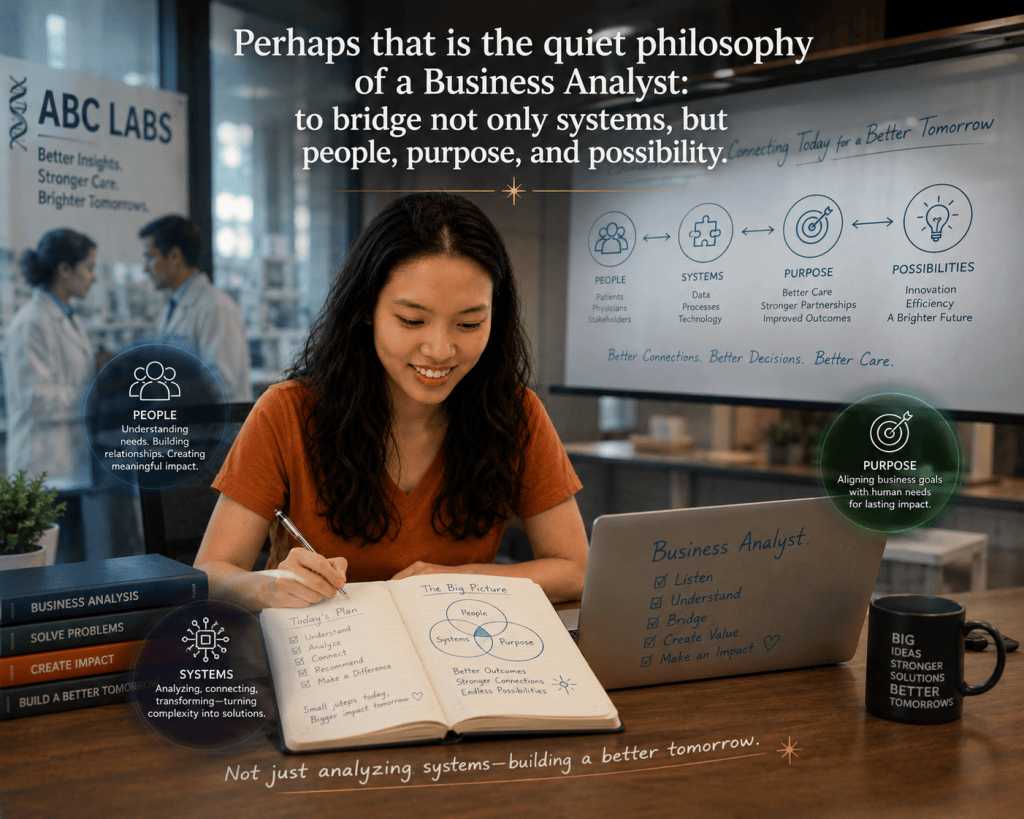
Perhaps that is the quiet philosophy of a Business Analyst: not merely to bridge systems or processes, but to bridge people, purpose, understanding, and possibility. The most successful analysts may never be remembered for the diagrams they created or the requirements they documented. Instead, they will be remembered for helping people see problems more clearly, make better decisions together, and create lasting value through understanding. That, more than any framework or methodology, is what business analysis has come to mean to me.