Introduction
One of the oldest philosophical and theological questions is how human beings can possess genuine free will if God is all-knowing and sovereign. If God already knows every future choice, are our decisions truly free? Molinism, developed by the sixteenth-century Jesuit theologian Luis de Molina, attempts to answer this dilemma through the concept of Middle Knowledge.
While Molinism provides an elegant framework for reconciling divine foreknowledge with human freedom, it also raises deep philosophical questions about contradiction and whether genuine freedom can exist if every choice is already known.
What Is Middle Knowledge?
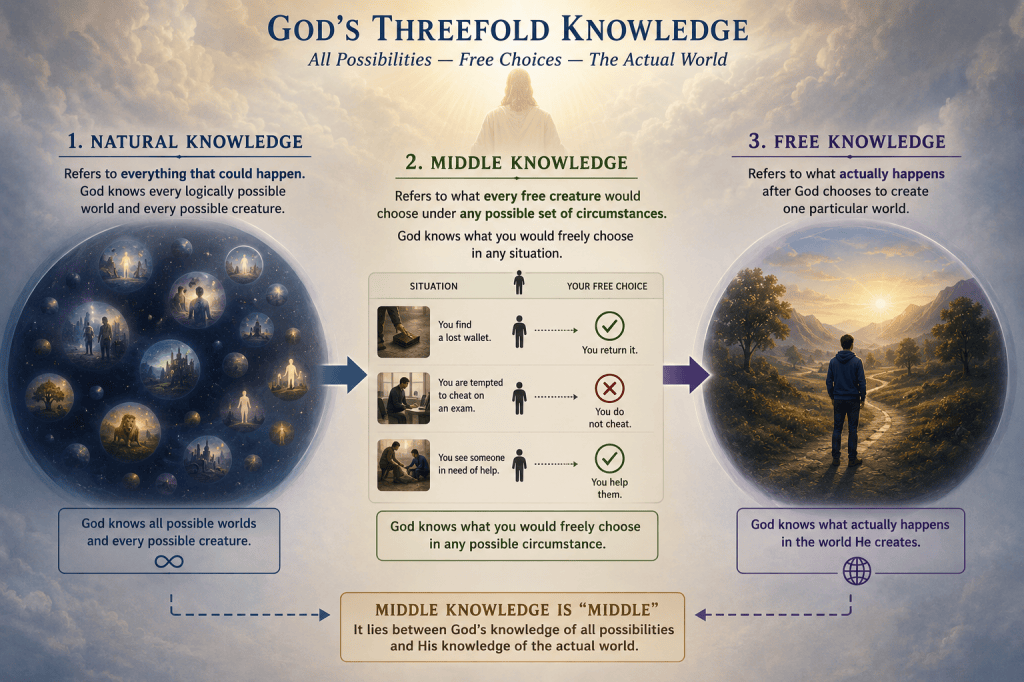
Molinism distinguishes three kinds of divine knowledge.
Natural Knowledge refers to everything that could happen. God knows every logically possible world and every possible creature.
Middle Knowledge refers to what every free creature would choose under any possible set of circumstances. For example, God knows that if a particular person were placed in a certain situation, they would freely choose one action instead of another.
Free Knowledge refers to what actually happens after God chooses to create one particular world.
Middle Knowledge is therefore “middle” because it lies between God’s knowledge of all possibilities and His knowledge of the actual world.
Molinism and Free Will
According to Molinism, God does not force human decisions. Instead, He knows beforehand how every person would freely act in every conceivable circumstance. God then chooses to create the world whose freely made decisions accomplish His purposes.
Imagine a chess grandmaster who knows every possible move an opponent could make. The grandmaster does not force those moves but understands every possible outcome and selects a strategy accordingly. Molinists argue that God’s knowledge is infinitely greater: He knows every possible free decision before creating the world.
This allows Molinism to preserve both divine providence and libertarian free will.
The Contradiction Problem
Critics argue that Molinism introduces a difficult contradiction.
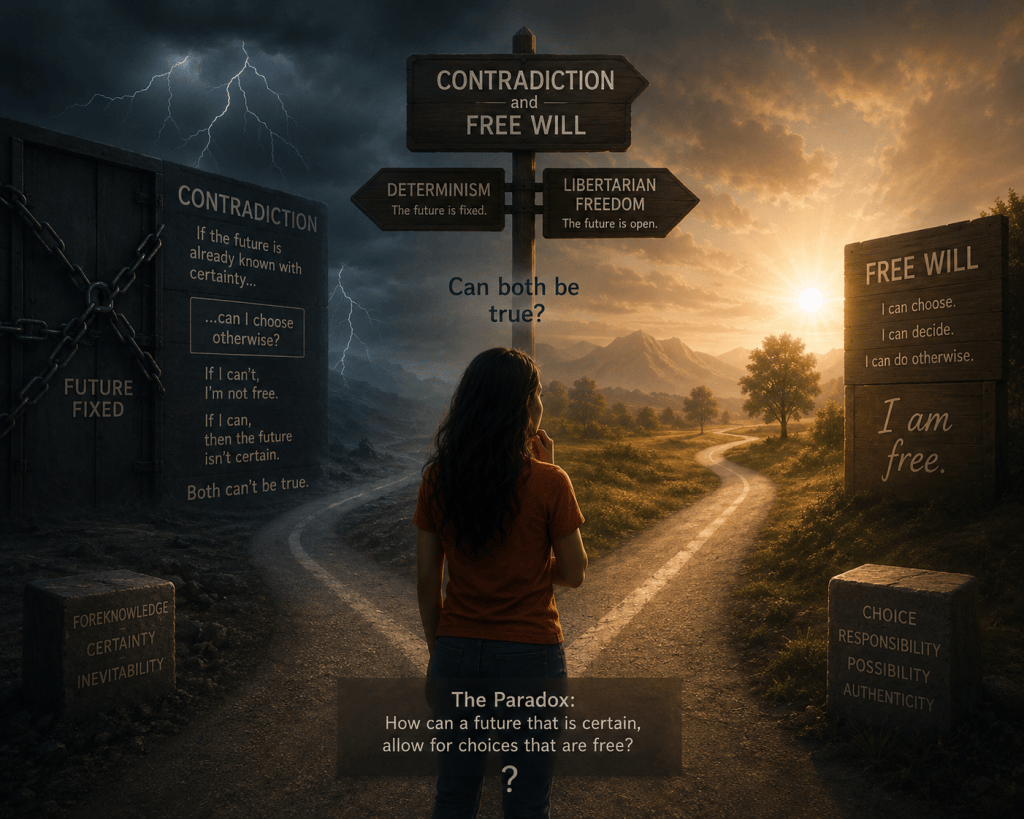
If God infallibly knows that a person will choose X tomorrow, can that person genuinely choose Y instead?
If the person cannot choose otherwise, freedom seems lost.
If the person can choose otherwise, then God’s knowledge would have been mistaken.
This creates what appears to be a logical contradiction between infallible foreknowledge and genuine alternative possibilities.
Molinists respond that God’s knowledge does not cause the action. Instead, the future free choice is the basis of God’s knowledge. God knows what the person will freely choose precisely because that is what they freely choose.
Critics reply that this explanation reverses the direction of explanation without eliminating the necessity. If the future is already true, then it appears impossible for the person to act differently.
The Grounding Objection
Perhaps the strongest criticism of Middle Knowledge is the grounding objection.
Before a person exists, what makes statements such as:
“If Sarah were placed in circumstance C, she would freely choose A.”
true rather than false?
Since no decision has yet occurred, critics argue there is nothing to “ground” the truth of these counterfactual statements.
If no truth-maker exists, then Middle Knowledge lacks a logical foundation.
Molinists answer that these counterfactual truths simply exist as part of God’s omniscient knowledge. Critics argue this merely assumes the very point in dispute rather than explaining it.
The Paradox of Free Will
The paradox can be summarized in four claims:
- God is infallible.
- God knows every future free action.
- Humans are genuinely free.
- Genuine freedom requires the ability to do otherwise.
Many philosophers argue that not all four statements can simultaneously be true.
Molinism attempts to preserve all four by distinguishing knowledge from causation. Knowing an event does not necessarily cause it.
However, critics maintain that certainty itself limits alternatives. If one outcome is already certainly true, then alternative choices are only hypothetical, not genuinely possible.
This is sometimes called the foreknowledge dilemma.
Possible Resolutions
Several philosophical positions attempt to resolve this paradox.
- Molinism maintains that God knows free choices without determining them.
- Theological Determinism argues that God determines every event, making free will compatible with divine sovereignty only in a compatibilist sense.
- Open Theism proposes that future free choices are not yet facts and therefore cannot be known as settled truths.
- Compatibilism redefines freedom as acting according to one’s desires, even if those desires are determined.
- Libertarianism insists that genuine freedom requires real alternative possibilities, making exhaustive foreknowledge difficult to reconcile.
Each view sacrifices or reinterprets at least one intuitive belief about freedom or divine knowledge.
Conclusion
Middle Knowledge represents one of the most sophisticated attempts to reconcile divine omniscience with libertarian free will. By claiming that God knows what every person would freely do in every possible circumstance, Molinism seeks to preserve both God’s sovereignty and human responsibility.
Yet the theory remains controversial. Questions about contradiction, the grounding of counterfactual truths, and whether certainty is compatible with genuine alternatives continue to fuel debate. The paradox of free will therefore remains one of philosophy’s most enduring problems: if the future is already perfectly known, in what meaningful sense is it still open?
Whether Molinism ultimately succeeds depends on whether one accepts its central claim that foreknowledge can be logically certain without being causally determining—a distinction that continues to divide philosophers and theologians today.