There was a moment when building my app stopped feeling exciting.
I had an idea. I started building it. Things were coming together, and for a while, everything felt surprisingly smooth.
Then came the dreaded message: 500 Internal Server Error.
Suddenly, the app that had looked so promising refused to cooperate.
I wasn’t sitting in a huge engineering team with experienced backend developers around me. I was trying to figure it out myself, using the tools available to me—including AI Studio.
So I started asking questions. The first attempt didn’t solve it.
I tried another approach. Still broken.
I prompted AI Studio again, changed things, tested the application, looked at what happened, and tried again.
Eventually, something changed. The error disappeared. The app worked.
And then came the moment that made it all worthwhile: I published it.
My Little David and Goliath Moment
Looking back, the experience reminded me of the story of David and Goliath.
The 500 error was my Goliath.
It wasn’t necessarily the biggest technical problem in the world, but at that moment, it stood between me and something I had built. It was intimidating because I didn’t immediately know how to defeat it.
And I was David—not because I had some magical technical ability, but because I had something much simpler: I kept trying.
AI became part of my toolkit. I didn’t expect it to magically build everything for me. I used it to investigate possibilities, understand potential causes, test solutions, and iterate.
One prompt didn’t solve the problem. Neither did the second. But eventually, through experimentation, I found the path forward.
The Real Lesson Wasn’t the Fix
The biggest thing I took away wasn’t simply learning how to resolve one particular server error.
It was learning that building software is also about debugging software.
Anyone can have an idea for an app. Anyone can imagine what the interface should look like. But eventually, something will break. An API won’t respond.
A database connection will fail. An environment variable will be missing.
A deployment will behave differently from the development environment.
And you’ll get another error message staring back at you.
That’s where the real learning begins. The goal isn’t to never encounter problems.
The goal is to become someone who can look at a problem and think: “Okay. Let’s figure this out.”
AI Doesn’t Replace the Learning
One thing this experience also taught me is that using AI doesn’t mean you stop learning. In fact, it can make the learning process much more interactive.
Instead of spending hours staring at an error with no direction, I could ask questions, investigate different possibilities, try suggested changes, and observe the results. But there’s an important distinction.
If I simply keep copying solutions until one happens to work, I haven’t really learned much. The real value comes from asking:
Why did this fix work? What caused the error? What would I check if the same thing happened again?
That’s the difference between getting an answer and developing a debugging skill.
From “Can I Build This?” to “What Can I Build Next?”
Getting the app published changed something for me.
Before this experience, the question was: “Can I actually build an app?”
Afterward, the question became: “What should I build next?”
That’s a surprisingly big shift. The first successful project gives you something that tutorials can’t quite provide: evidence.
Evidence that an idea can become a real application. Evidence that problems can be solved. Evidence that you can start with something you don’t completely understand and gradually work your way through it. And perhaps most importantly, evidence that you don’t need to know everything before you begin.
Every Builder Gets Their Goliath
My 500 error wasn’t some legendary engineering challenge. But it was my challenge.
And that’s what made it meaningful.
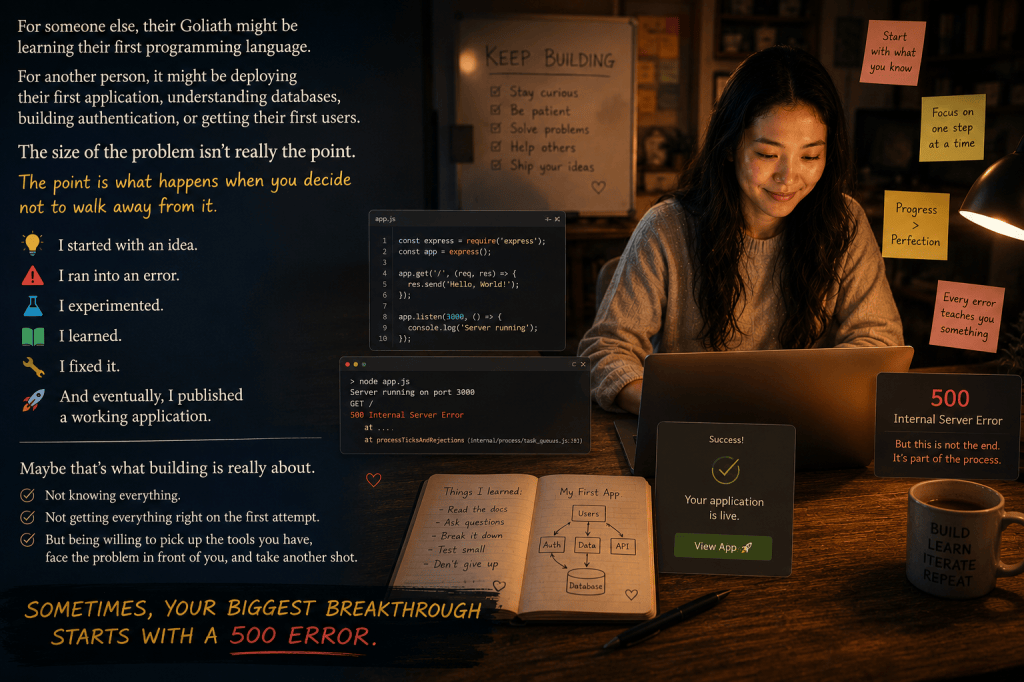
For someone else, their Goliath might be learning their first programming language. For another person, it might be deploying their first application, understanding databases, building authentication, or getting their first users.
The size of the problem isn’t really the point. The point is what happens when you decide not to walk away from it.
I started with an idea. I ran into an error. I experimented. I learned. I fixed it. And eventually, I published a working application. Maybe that’s what building is really about.
Not knowing everything. Not getting everything right on the first attempt.
But being willing to pick up the tools you have, face the problem in front of you, and take another shot.
Sometimes, your biggest breakthrough starts with a 500 error.