A few weeks ago, I wrote about the refreshed Knowledge and Inquiry (KI) syllabus and why I think philosophy needs to keep evolving.
You can read my original post here:
“Why Philosophy Needs to Keep Evolving: Reflections on the New Knowledge and Inquiry Syllabus”
https://jeroybrighterfuture.school.blog/2026/07/22/why-philosophy-needs-to-keep-evolving-reflections-on-the-new-knowledge-and-inquiry-syllabus/
Reading about the changes to the syllabus got me thinking about something bigger.
What happens when students leave Junior College? What happens when they go to university, encounter new ideas, new technologies and increasingly powerful AI tools?
That question became one of the reasons I created Nous.
Nous is designed for university students, as well as anyone who is interested in learning more about philosophy and developing stronger habits of thinking and inquiry.
The “Wait, What Do I Actually Believe?”
Here is a simple example.
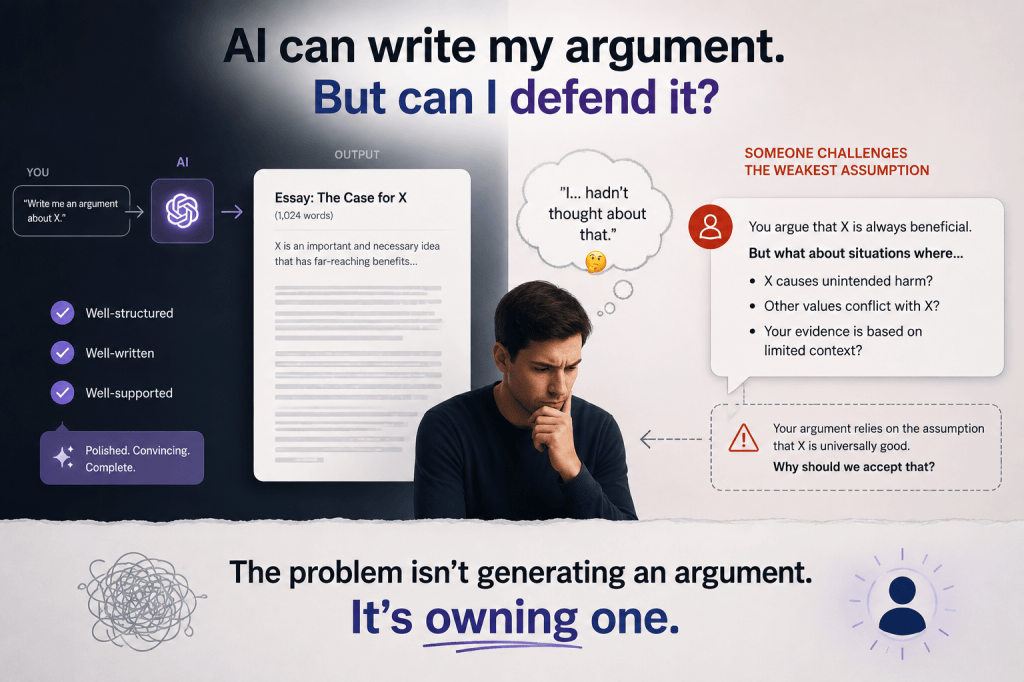
AI can write my argument. But can I defend it?
Imagine a student asks:
“Write me an argument about X.”
AI produces a polished 1,000-word essay.
Everything looks convincing.
Then someone challenges the weakest assumption in the argument.
↓
🤔 “I… hadn’t thought about that.”
And suddenly, we have a problem.
The problem isn’t generating an argument.
It’s owning one.
This is where I think philosophy still has an important role to play.
It is not enough to produce something that sounds intelligent. We need to understand the assumptions behind our arguments, examine the evidence, consider alternative perspectives and be prepared to change our minds when the reasoning demands it.
That is the kind of thinking I want Nous to encourage.
From KI to university and beyond
The refreshed KI syllabus reminded me that philosophy is not simply about studying philosophers from the past.
It is about learning how to question knowledge, examine assumptions and think carefully about what we believe.
Those skills do not become less important after Junior College.
If anything, they become more important.
University students are entering a world where AI can help them write, research, debate and create at an extraordinary speed.
But perhaps the most important question is still a very old philosophical one:
What do I actually believe — and why?
That is the question behind Nous. Not just “Can AI give me an answer?”
But: “Can I understand it, question it and defend my own thinking?”
And perhaps that is where the next chapter of philosophy begins.