When people think of philosophy, they often imagine ancient thinkers discussing questions that have puzzled humanity for centuries. What is truth? How do we know what we know? What makes something right or wrong?
These questions have not changed. But the world around them certainly has.
That is why the Ministry of Education’s refreshed Knowledge and Inquiry (KI) syllabus, which will be introduced in 2027, is such an encouraging development. Rather than changing what philosophy is about, it recognises that philosophy must continue to evolve alongside society. After all, the purpose of philosophy has never been to memorise old ideas—it is to help us think more clearly about new ones.

Today’s students are growing up in a world where artificial intelligence can write essays, generate images and answer questions in seconds. Information is everywhere, but knowing what to trust has become increasingly difficult. This makes philosophy more relevant than ever.
One of the biggest changes in the new KI syllabus is the introduction of the idea of “cognition and conscience.” In simple terms, students are encouraged to think about two equally important questions: How is knowledge created? and How should knowledge be used responsibly?
These are not just academic questions. They are questions that young people are already encountering in everyday life.
Can we trust information generated by AI? Should technology make decisions for us? Just because we can do something, does it mean we should?
These are philosophical questions, and there are no easy answers. What philosophy offers is a way of thinking carefully and critically before reaching a conclusion.
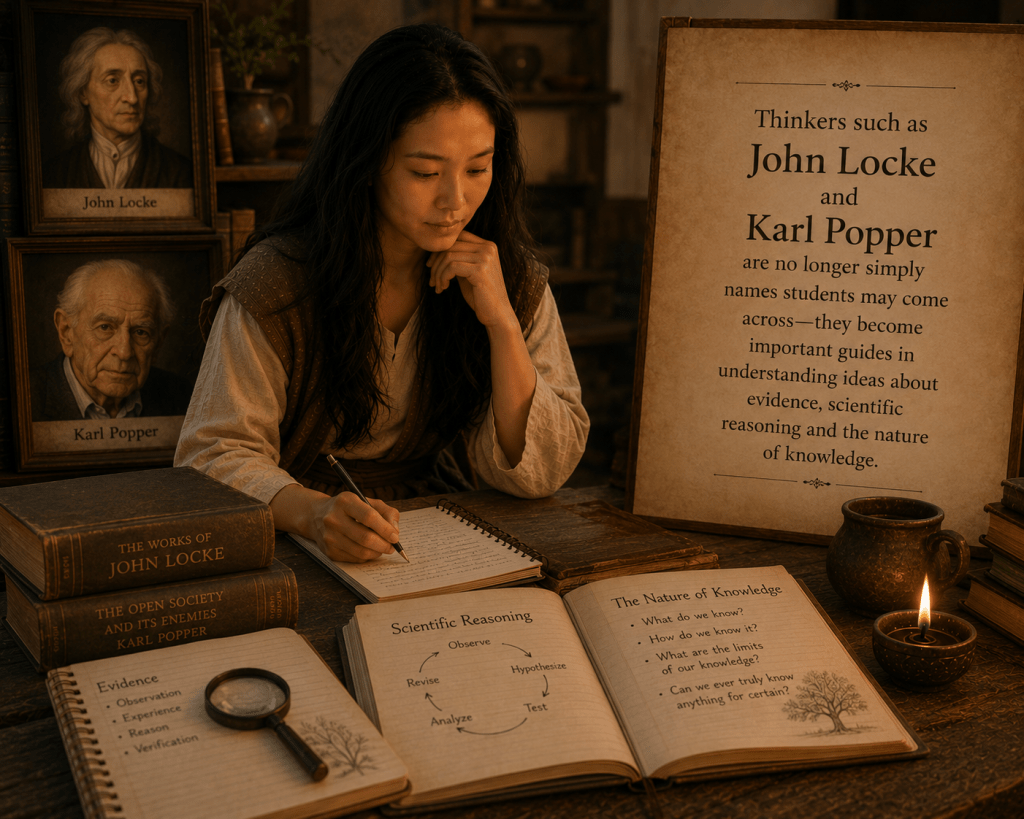
Another welcome feature of the refreshed syllabus is that it provides students with a stronger foundation by introducing key philosophers and concepts more explicitly. Thinkers such as John Locke and Karl Popper are no longer simply names students may come across—they become important guides in understanding ideas about evidence, scientific reasoning and the nature of knowledge.
Learning philosophy has never been about agreeing with these thinkers. Instead, students learn to question them, challenge them and build upon their ideas. In many ways, that is exactly what philosophy has always encouraged: respectful disagreement in the pursuit of deeper understanding.
The syllabus also introduces a consistent inquiry framework that students can apply across different topics. Whenever they encounter a new claim or idea, they are encouraged to ask questions such as:
- Who produced this knowledge?
- What evidence supports it?
- What assumptions are being made?
- How might culture, history or politics have shaped it?
- Who benefits from this knowledge, and who might be affected by it?
These questions are useful far beyond the classroom. Whether students are reading the news, evaluating social media posts or discussing scientific breakthroughs, they are learning to pause, examine and think before accepting information at face value.
Perhaps that is the greatest value of philosophy today. It teaches students not what to think, but how to think.
The refreshed syllabus also places greater emphasis on intellectual qualities such as humility, open-mindedness and conscientiousness. These may sound like simple values, but they are becoming increasingly important in a world where opinions spread quickly and certainty is often mistaken for wisdom.
Being intellectually humble means recognising that we might not have all the answers. Being open-minded means being willing to consider different perspectives. Being conscientious means taking care to evaluate evidence before forming conclusions. These habits of mind are valuable not only in examinations but throughout life.
The updated KI syllabus reminds us that philosophy is not a subject trapped in the past. It is a living discipline that continues to help us make sense of an ever-changing world. While the questions may take on new forms—from artificial intelligence to emerging technologies—the skills that philosophy develops remain remarkably constant: curiosity, careful reasoning and thoughtful reflection.
As the world changes, our education must change too. The refreshed Knowledge and Inquiry syllabus shows that philosophy is more than capable of keeping pace. In fact, it may be one of the subjects best equipped to help students navigate uncertainty with confidence, integrity and wisdom.
In the end, philosophy is not about having all the answers. It is about learning to ask better questions. And in today’s rapidly changing world, that may be one of the most valuable lessons of all.
 All about Lina Lifestyle