Reflections on authenticity, Gen Z, and why polished professionalism may not satisfy our deepest spiritual longings.
In a recent conversation, I heard a university professor describe the Asbury Revival in a way that has stayed with me ever since. He spoke not about the crowds or the headlines, but about how visceral the experience was.
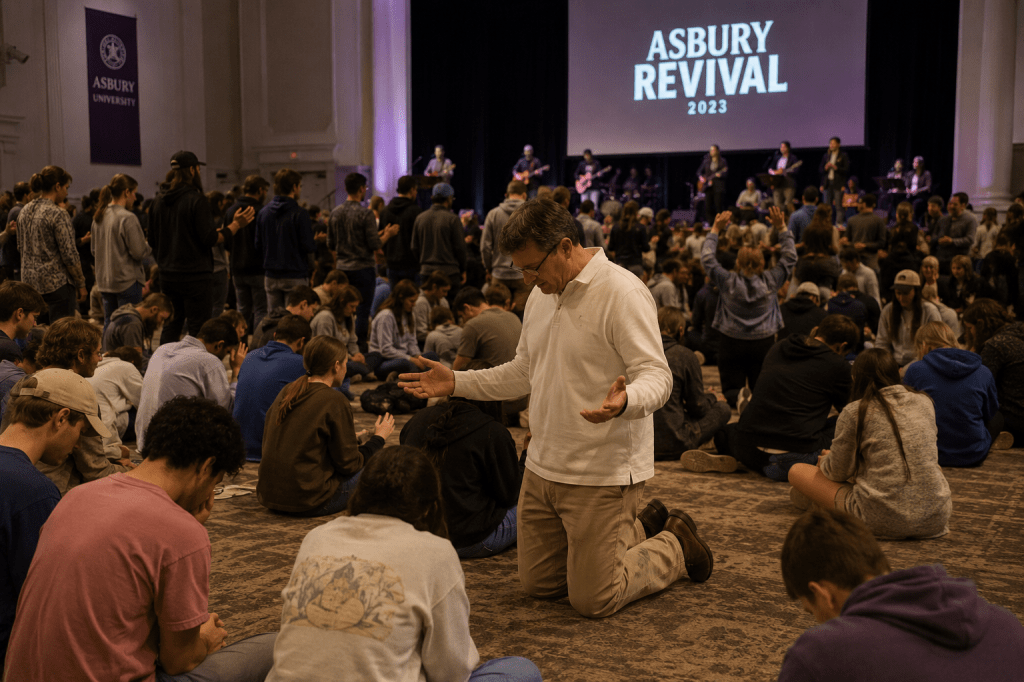
It began with what was meant to be an ordinary chapel service at Asbury University in February 2023. Instead of leaving when the service ended, a small group of students remained behind to pray. Others joined them. Hours turned into days. Worship continued around the clock. There were no celebrity pastors, no elaborate production, no marketing strategy—just students praying, confessing, singing, reading Scripture, and seeking God together.
What struck the professor most was not simply that it happened, but how it happened. It felt raw, genuine, and unforced.
A Generation Looking for Something More
One of the professor’s observations was that Gen Z has become one of the largest and fastest-growing groups expressing interest in faith and spirituality. While many have assumed younger generations are abandoning religion altogether, he believes many are actually searching for something deeper than institutional affiliation or polished experiences.
In his view, many young people are longing for authenticity. They have grown up in a world shaped by social media, constant comparison, and carefully curated identities. They have become remarkably good at recognizing when something feels manufactured.
Perhaps that is one reason why the simplicity of the Asbury Revival resonated with so many people.
When Everything Becomes a Product
The professor also offered a challenging thought: our culture of professionalism and commoditization may actually be diminishing our hunger for faith.
Today, nearly everything is optimized. We measure performance, track engagement, refine presentations, build brands, and seek efficiency. These are not inherently bad things. In many contexts, professionalism serves people well.
But when this mindset becomes the lens through which we approach every part of life, even faith can begin to feel like another product to consume.
Churches can unintentionally fall into this pattern. Services become increasingly polished. Worship becomes a production. Ministries become programs. Success is measured by attendance, engagement, and growth metrics.
Again, excellence is not the problem.
The question is whether our pursuit of excellence sometimes overshadows our dependence on God.
The Things We Cannot Manufacture
The professor suggested that the most meaningful moments of faith often cannot be scheduled or engineered.
Repentance cannot be programmed.
Conviction cannot be marketed.
The presence of God cannot be manufactured.
The Asbury Revival seemed to remind people of this reality. There was no attempt to create a spectacle. There was simply space for people to remain, pray, worship, confess, and listen.
Perhaps what made it powerful was precisely what made it ordinary.
A Different Kind of Success
In many areas of life, professionalism is necessary. Organizations need good leadership. Churches benefit from thoughtful planning. Excellence honors both people and God.
Yet there is also a danger when professionalism becomes our greatest strength.
If every moment is scripted, every experience optimized, and every outcome measured, we may lose our capacity to wait, to wonder, and to hunger for God in ways that cannot be controlled.
The Asbury Revival reminds us that spiritual renewal rarely begins with impressive strategies. More often, it begins with ordinary people who are willing to linger in God’s presence.
Final Reflection
Whether one views the Asbury Revival as a genuine revival or simply a remarkable spiritual awakening, it raises an important question for all of us.
In a culture that prizes efficiency, optimization, and polished experiences, have we left enough room for genuine encounters with God?
Perhaps the deepest hunger of our generation is not for a better performance, but for a real presence.
And perhaps revival begins not when we perfect our programs, but when we rediscover our dependence on God.
 All about Lina Lifestyle