What prompt engineering taught me about the way we think, question, and solve problems.
There was a time when I thought using AI was simple.
You had a question.
You typed it.
AI gave you an answer.
Done.
But the more I worked with AI, the more I realised something uncomfortable:
The quality of the answer often depends on the quality of the thinking behind the question.
And that changed the way I started looking at prompt engineering.
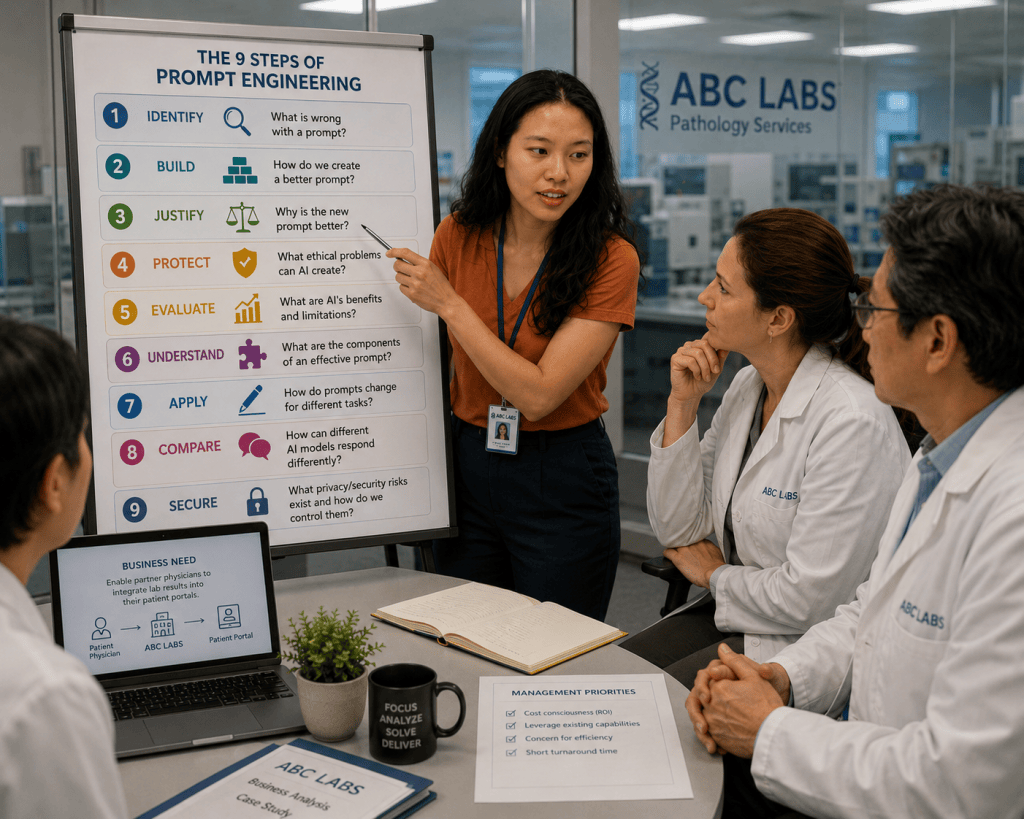
A Prompt Is More Than a Question
At first, I saw a prompt as an instruction.
“Write a social media caption.”
“Analyse this business problem.”
“Create a marketing proposal.”
But these prompts leave a lot unsaid.
Who is the audience?
What is the objective?
What information does the AI need?
What tone should it use?
What should the final output look like?
What should it avoid?
The more I explored prompt engineering, the more I realised that writing a good prompt is surprisingly similar to business analysis.
Both begin with understanding.
Before solving a problem, we need to understand the problem.
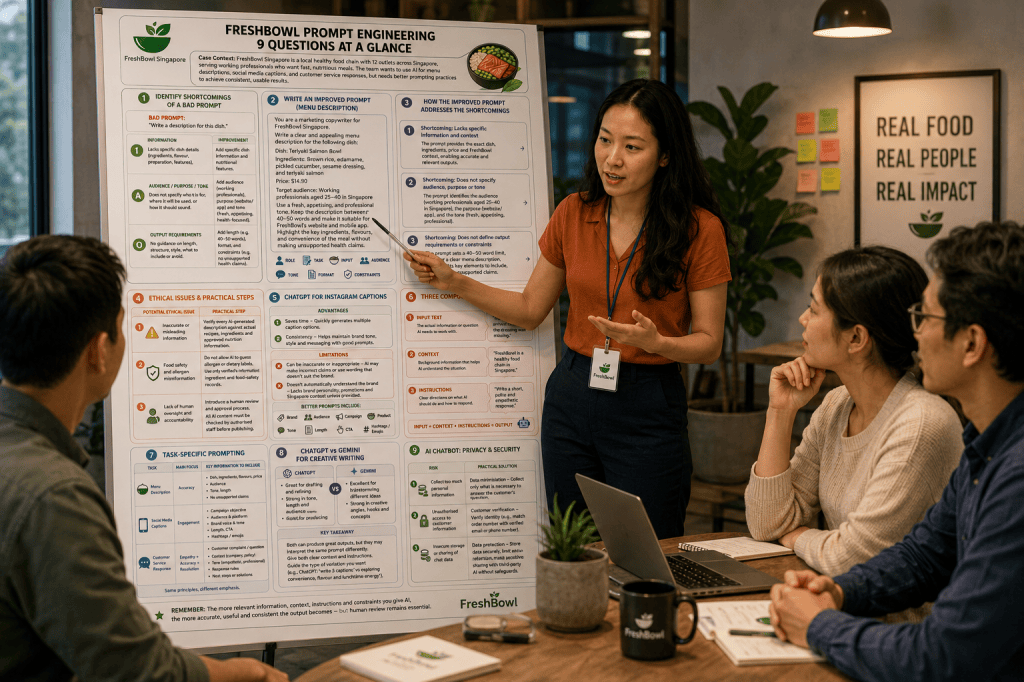
The Nine Questions That Changed My Thinking
While preparing for my prompt engineering assessment, I started organising the subject around nine questions:
1. IDENTIFY
What is wrong with the prompt?
2. BUILD
How do we create a better prompt?
3. JUSTIFY
Why is the new prompt better?
4. PROTECT
What ethical problems can AI create?
5. EVALUATE
What are AI’s benefits and limitations?
6. UNDERSTAND
What are the components of an effective prompt?
7. APPLY
How do prompts change for different tasks?
8. COMPARE
How can different AI models respond differently?
9. SECURE
What privacy and security risks exist?
Looking at these questions together, I realised that prompt engineering isn’t really about finding the perfect sentence.
It is about thinking systematically before asking AI to think with us.

The Connection to Business Analysis
This brought me back to something I wrote about previously: business analysis is the art of understanding.
A business analyst doesn’t simply receive a problem and immediately jump to a solution.
They ask: What is actually happening? Who is affected? Why is this happening?
What does the business really need? What constraints exist?
What would a successful outcome look like?
Prompt engineering follows a remarkably similar pattern.
A weak prompt jumps straight to the task.
A strong prompt establishes the thinking around the task.
That might mean defining the role, context, objective, audience, constraints, format, tone and expected output.
Suddenly, the prompt becomes more than an instruction.
It becomes a mini-brief.
AI Doesn’t Remove the Need to Think
This is probably the biggest lesson I have taken away.
AI can make us faster.
It can generate ideas.
It can summarise information.
It can create alternatives.
It can help us see possibilities we might not have considered.
But speed isn’t the same as understanding.
A beautifully written AI response can still be wrong.
A confident answer can still contain assumptions.
A detailed explanation can still miss the actual business problem.
And a sophisticated prompt can still produce an inappropriate result.
That is why human judgement remains essential.
From Prompt Engineering to Thought Engineering
Perhaps that is what interests me most about prompt engineering.
It isn’t really about becoming better at talking to machines.
It is about becoming more deliberate in how we communicate our own thinking.
A good prompt forces us to clarify:
What do I actually want? Why do I want it? Who is it for?
What information matters? What constraints exist?
How will I know if the answer is good?
Those are not just AI questions.
They are business questions.
They are analytical questions.
And, ultimately, they are human questions.
My Takeaway
I started learning prompt engineering because I wanted to understand how to get better results from AI.
I am coming away with something slightly different.
AI doesn’t replace the need for good thinking.
In many ways, it makes good thinking even more important.
The better we understand the problem, the better we can communicate it.
The better we communicate it, the more useful AI becomes.
And the more we question the answer, the less likely we are to confuse an impressive response with a correct one.
Maybe the future isn’t about humans versus AI.
Maybe it is about learning how to think better with AI.
And perhaps that is where prompt engineering really begins.
A question I’m taking forward
If AI can answer almost any question, perhaps the real skill is learning which questions are worth asking.
#AI #PromptEngineering #BusinessAnalysis #ArtificialIntelligence #CriticalThinking #FutureOfWork #DigitalTransformation #LearningJourney

