“For I know the plans I have for you,” declares the Lord, “plans to prosper you and not to harm you, plans to give you hope and a future.” — Jeremiah 29:11 (NIV)
There are moments when I look back and realise that the person who began a journey months ago is not quite the same person standing here today. July feels like a different chapter. I was learning, questioning, trying to understand where my interest in artificial intelligence might lead. I did not have a complete picture of what was ahead. I only had the next lesson, the next challenge, and a growing conviction that I wanted to build something meaningful.
Today, in November, I find myself looking back with gratitude. I have completed my AI Operations Specialist training, graduated in October, developed two AI projects, and then gone on to create a third Google AI Studio project after graduation. What began as a period of learning has gradually become a season of building, exploring and discovering new possibilities.

From learning about AI to building with intention
When I started this chapter, I was focused on learning new skills and understanding how AI could be applied in practical settings. The training introduced me to areas such as prompt engineering, conversational AI, AI operations, project work, responsible AI and data privacy. It also gave me opportunities to work with others, solve problems and learn through experimentation.
My capstone experience was an important part of that journey. Working with a team, taking responsibility for the project and troubleshooting an integration challenge taught me that building with technology is rarely a straight line. Sometimes progress comes from patiently identifying what is not working, asking better questions and trying another approach.
Graduation in October was a milestone, but it did not feel like the end of the journey. In many ways, it became the beginning of a new one. I was no longer only learning about AI through a course. I was beginning to explore what I could create with what I had learned.
NOÛS: making space for deeper thinking
One of the projects that emerged from this period was NOÛS, an AI Philosophy Symposium and Thesis Lab. Its central idea is simple: AI should not merely make it easier to obtain answers; it should help people become better thinkers.
NOÛS grew from my interest in philosophy, critical thinking and the questions raised by artificial intelligence. I wanted to explore an environment where a learner could formulate an idea, have it challenged, reconsider assumptions, revise an argument and eventually defend a position. The aim is not to replace a learner’s thinking with an AI-generated response. It is to create space for intellectual development.
AI made answers cheap. Thinking is still hard.
That thought continues to guide the project. The outcome I hope to encourage is not simply, “I received an answer,” but “I understand my position, and I can defend it.”
NOESIS: bringing human judgement into AI-supported decisions
A second project, NOESIS, took my exploration in another direction: human-centred AI decision support for security operations. Here, the question is how AI might help people organise evidence, notice anomalies and investigate incidents without surrendering their judgement to a system.
One principle became especially important to me: AI confidence is not the same as truth. An alert may be useful, but it is not proof. A score may draw attention to something, but people still need to examine the evidence, identify what is missing, consider alternative explanations and make a defensible decision.
NOESIS helped me think about how the ideas behind human-centred AI could apply beyond education. In one project, I was exploring how people learn to reason. In the other, I was exploring how people can reason responsibly when using AI to support operational decisions. Different settings, but a shared belief: technology should strengthen human judgement, not quietly replace it.
A third project after graduation: LinaNexus AI
Then came another unexpected step. After graduating in October, I created a third Google AI Studio project: LinaNexus AI — AI Brand Strategy Dossier.
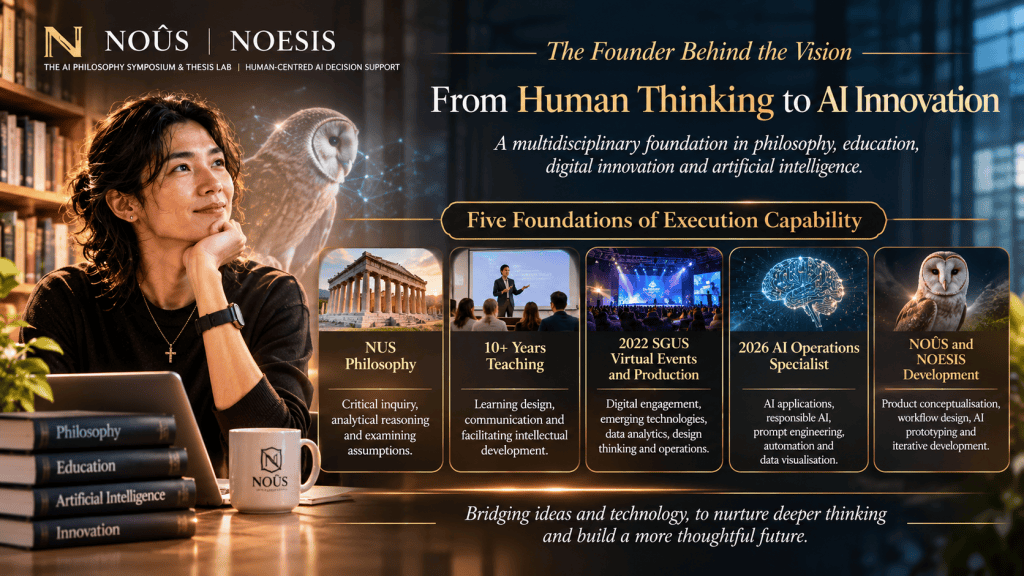
This project marks a shift in how I am looking at my work. I had spent months developing ideas and prototypes. Now I wanted to bring the different strands together: my interests, the problems I care about, the projects I have built, and the way I communicate their value to others.
LinaNexus AI represents an effort to think more deliberately about positioning, identity and the connections between ideas. It is not simply another AI experiment. It is part of my attempt to understand how NOÛS and NOESIS can be presented clearly, how their purposes differ, and how they might create opportunities for collaboration, learning and real-world exploration.
You can explore the project here: LinaNexus AI — AI Brand Strategy Dossier.
Looking at these three projects together, I can see a developing thread. NOÛS explores intellectual development. NOESIS explores human judgement in AI-supported security decisions. LinaNexus AI helps me bring ideas, identity and strategy into a more coherent picture. They are distinct projects, still developing, but each reflects a different part of the same learning journey.
New connections, new questions and a wider horizon
Along the way, I have also begun stepping into conversations and communities beyond the classroom. Attending innovation events, sharing my ideas, demonstrating NOÛS and speaking with people from different professional and academic backgrounds have reminded me that a project develops not only through building, but also through listening.
Some conversations have opened up new questions. Could a Socratic learning environment work across languages? What might a pilot with learners look like? How could human-centred AI support organisations? What would it take to move a promising prototype towards practical use?
I do not have all the answers. Perhaps that is part of the point. I am learning to take the next step without needing to see the entire road. I am also learning that an introduction, a conversation or a small opportunity to demonstrate an idea can be valuable even when it does not immediately lead to a concrete outcome.
Looking back with gratitude
When I think about the months since July, I see more than a list of completed tasks. I see the effort behind each attempt, the problems that needed patience, the ideas that changed as I tested them, and the courage it took to share work that was still evolving.
I am grateful for the people who taught me, encouraged me, responded to my ideas and gave me opportunities to learn. I am grateful for the moments when something finally worked after repeated attempts. I am grateful, too, for the uncertain moments, because they reminded me that growth is not always accompanied by immediate clarity.
My faith has been part of how I make sense of this season. Jeremiah 29:11 is often quoted as a promise of hope, but its original setting matters: it was spoken to a people living through exile, with restoration still some distance away. It was not a promise that every difficulty would disappear overnight. It offered hope in the middle of a longer story.
That context makes the verse especially meaningful to me. I do not read it as a guarantee that every project will succeed exactly as I imagine, or that every opportunity will unfold according to my preferred timetable. I read it as an invitation to keep faith, remain open to growth and trust that a season of uncertainty does not mean that the story has no direction.
Moving forward with hope
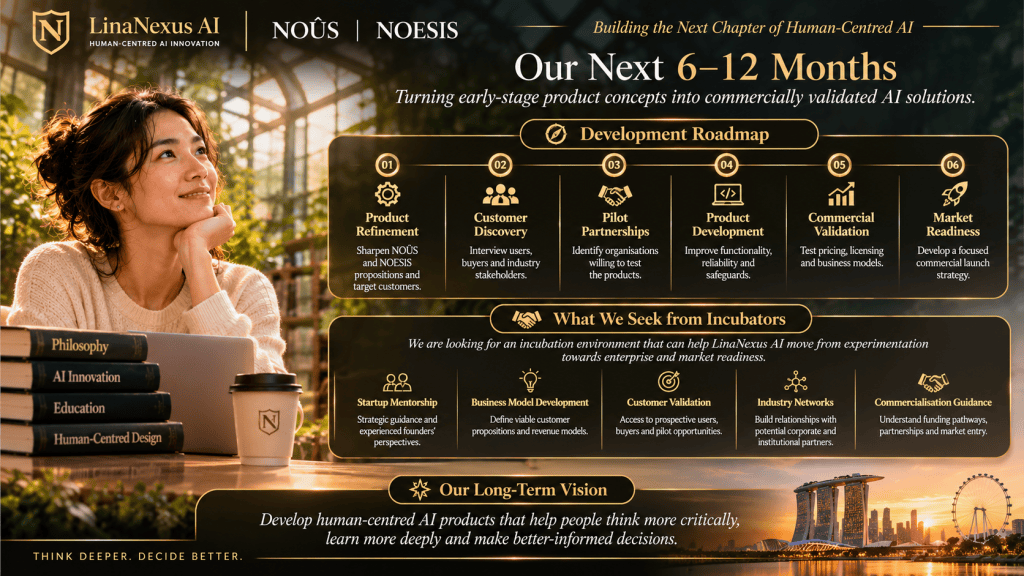
As I enter this new chapter, I want to keep learning, but I also want to build with greater intention. I hope to develop NOÛS through meaningful feedback and opportunities to test it with learners. I hope to explore how NOESIS might be evaluated in relevant operational settings. And I want LinaNexus AI to help me communicate the ideas and purpose behind this work with greater clarity.
There is still much to learn. There will be revisions, unanswered questions and probably a few more technical problems that require patience. But I no longer see the journey only as a transition from one course or role to another. I see it as an ongoing process of discovering how my experience, interests and capabilities can come together in work that is useful to others.
July gave me a starting point. October gave me a milestone. November finds me building again — this time with three projects, a wider perspective and a clearer sense of the questions I want to pursue.
I am looking back with gratitude, not because everything is complete, but because there is so much to be thankful for. And I am moving forward with hope, knowing that I do not need to have the whole plan figured out to take the next faithful step.
“For I know the plans I have for you…” — Jeremiah 29:11
A reminder to keep going, with faith and hope.