What if AI could do more than generate answers? What if it could help us become better thinkers?
This question lies at the heart of NOÛS — AI Philosophy Symposium & Thesis Lab, an experimental learning project exploring how Socratic dialogue and AI-assisted intellectual exploration can support independent reasoning.

A Visual Representation of Thinking
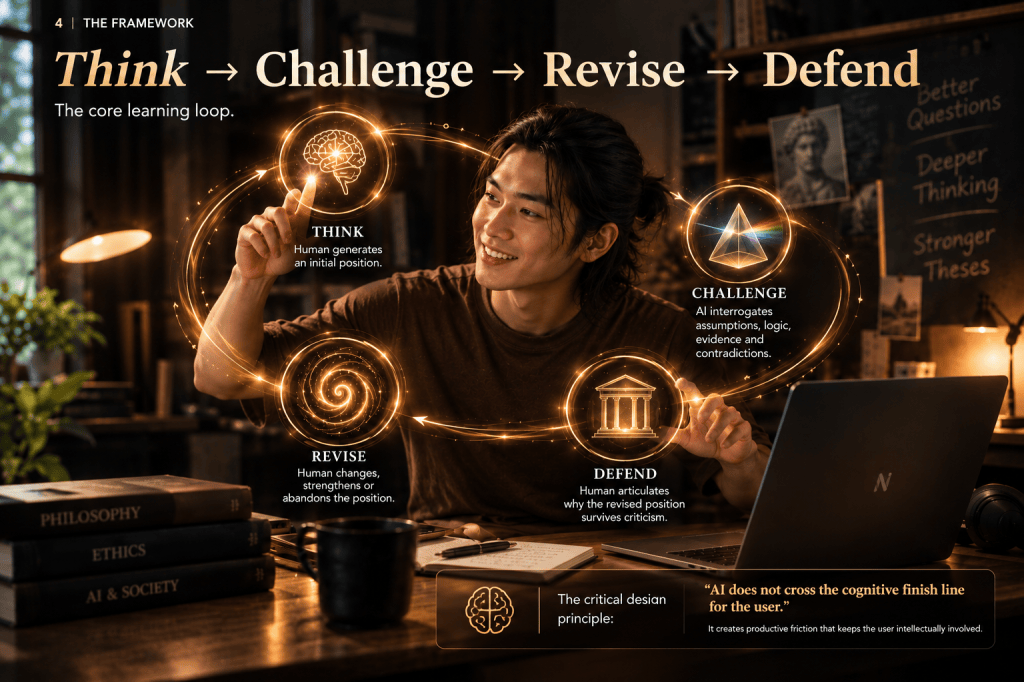
The Think → Challenge → Revise → Defend cycle captures a different approach to learning. Instead of simply asking AI for an answer and accepting it, learners are invited to actively participate in the development of their own ideas.
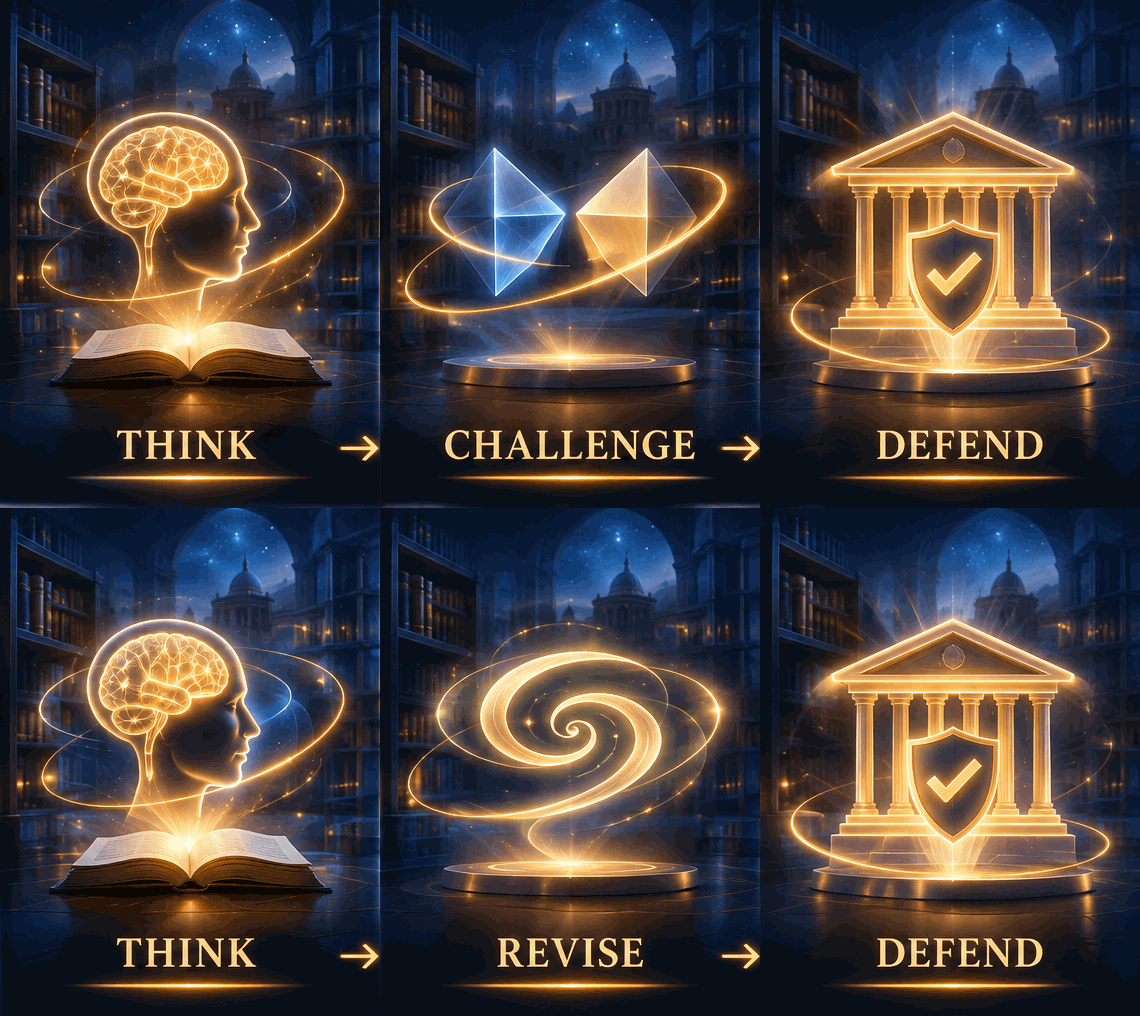
1. THINK — Form your own ideas
Begin with a question, an observation, or an initial position. Learning starts when we are willing to think for ourselves—even when our ideas are still incomplete.
2. CHALLENGE — Examine your assumptions
Invite questions, counterarguments, and alternative perspectives. A good challenge does not merely tell us that we are wrong; it helps us see what we may have overlooked.
3. REVISE — Strengthen your reasoning
Reflect on what the challenge reveals. Clarify your claims, reconsider assumptions, and refine your argument. Revision is not a sign of failure—it is part of intellectual growth.
4. DEFEND — Explain what you believe and why
Can you articulate your position and support it with reasons? Can you respond thoughtfully to objections? The goal is not to win an argument at all costs, but to develop a position you can genuinely understand and defend.
AI as an Intellectual Sparring Partner
AI makes it increasingly easy to obtain explanations, summaries, and polished answers. But access to an answer is not the same as understanding it—and accepting an AI-generated response is not the same as developing independent reasoning.
In NOÛS, AI is envisioned not simply as an answer generator, but as an intellectual sparring partner: one that can question, challenge, and help learners explore ideas while leaving the responsibility for thinking with the human learner.
AI made answers cheap. Thinking is still hard.
The Outcome: “I Can Defend It.”
The aspiration behind this learning cycle is simple: learners should leave not merely with an answer, but with greater clarity about what they think, why they think it, and how they can explain their reasoning.
That is the difference between borrowing certainty and developing understanding.
Explore the NOÛS concept and its experimental learning environment: NOÛS — AI Philosophy Symposium & Thesis Lab.
As this project continues to evolve, I hope to keep exploring a meaningful question: How can AI help us think more deeply, rather than think less?

