Sometimes, a new chapter begins not with a carefully laid-out plan, but with a simple decision to show up.
For me, that decision was attending SWITCH 2026 (Singapore Week of Innovation and Technology).
I had recently completed my Artificial Intelligence Specialist training, a journey that challenged me to learn new technologies, explore AI applications, and think more deeply about the relationship between artificial intelligence and human intelligence.
After an intensive period of learning, assessments, and project development, I wanted to take a step back and explore the world beyond the classroom.
I wanted to see how AI was being used in the real world. I wanted to hear from people working in innovation, discover what organisations were trying to solve, and explore where my own interests and ideas might fit.
What I did not expect was how much the experience would help me reflect on my future.

1. Saying Yes to an Unexpected Opportunity
I first discovered SWITCH through a recommendation on my LinkedIn feed.
Initially, I was weighing different opportunities and considering how best to spend my time after completing my AI training. I had already spent months developing my technical knowledge, and I was beginning to wonder what the next stage of my journey should look like.
Should I pursue another course? Continue building my AI projects? Look for a job? Or step into the wider innovation community and start having conversations with people in the industry?
Eventually, I decided to attend SWITCH.
Rather than committing myself to another intensive course or assessment, I chose an opportunity to learn through observation, conversations, and exploration.
It felt like a different kind of learning.
Instead of sitting in a classroom trying to master another tool, I could walk around an exhibition, listen to industry conversations, discover emerging technologies, and speak directly with people who were working on real-world problems.
I was giving myself permission to explore without needing to have all the answers.
Sometimes, that is exactly what we need after a demanding season: not another test of what we know, but an opportunity to discover what genuinely interests us.
2. From Feeling Unfamiliar to Finding My Confidence
Walking into an innovation event can feel different when you are no longer attending as part of a course.
When you have classmates and trainers around you, there is a familiar structure. You know why you are there, what you are expected to do, and who you can turn to.
But attending as an individual means taking more initiative.
You have to decide which conversations to pursue, which technologies deserve your attention, and how to introduce yourself to people who may have very different professional backgrounds.
On the first day, I was still finding my footing.
By the second day, something began to change.
I found myself warming up to conversations with people from organisations such as CapitaLand, Singapore Airlines, and exhibitors connected with California.
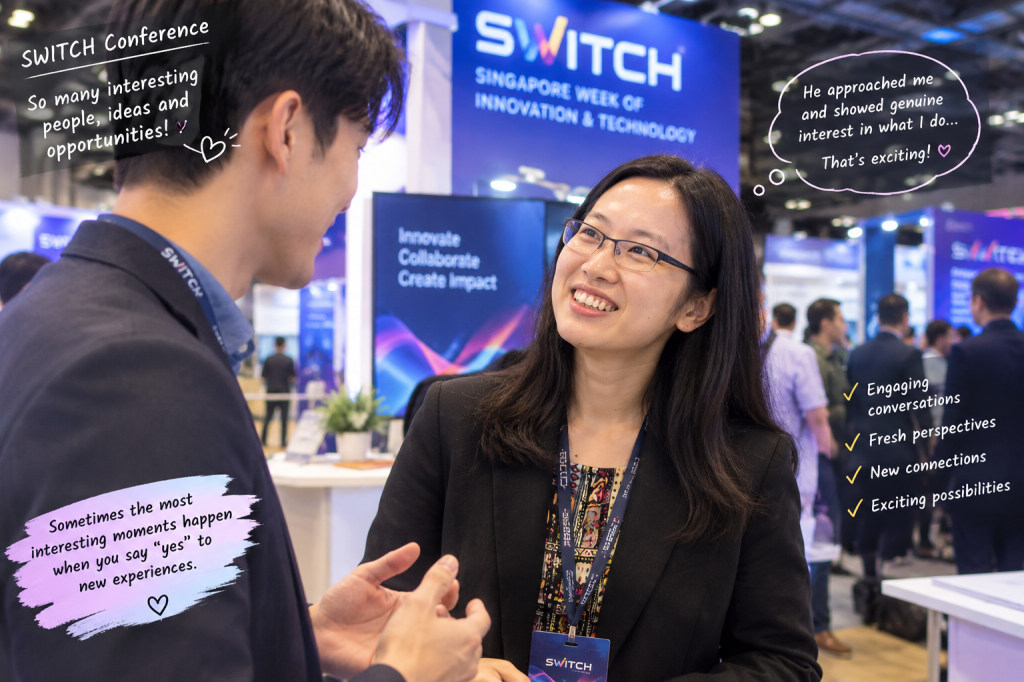
I was becoming more comfortable approaching people, asking questions, and exploring what they were doing.
It was not simply about overcoming nervousness. I was also experiencing curiosity, enjoyment, and a growing sense of belonging.
I began to appreciate the value of being in a room filled with people who were exploring new possibilities.
There were different industries, different challenges, and different approaches to innovation. Every conversation offered a chance to learn something I might not have discovered on my own.
I realised that networking did not have to mean walking around trying to impress people or convincing them to buy something.
It could begin with a much simpler question:
What are you working on, and what can I learn from your experience?
That shift made the experience feel more natural to me.
I was not there merely to collect business cards. I was there to discover connections between ideas, people, and possibilities.
3. The Moment When My NOÛS Ideas Met the Real World
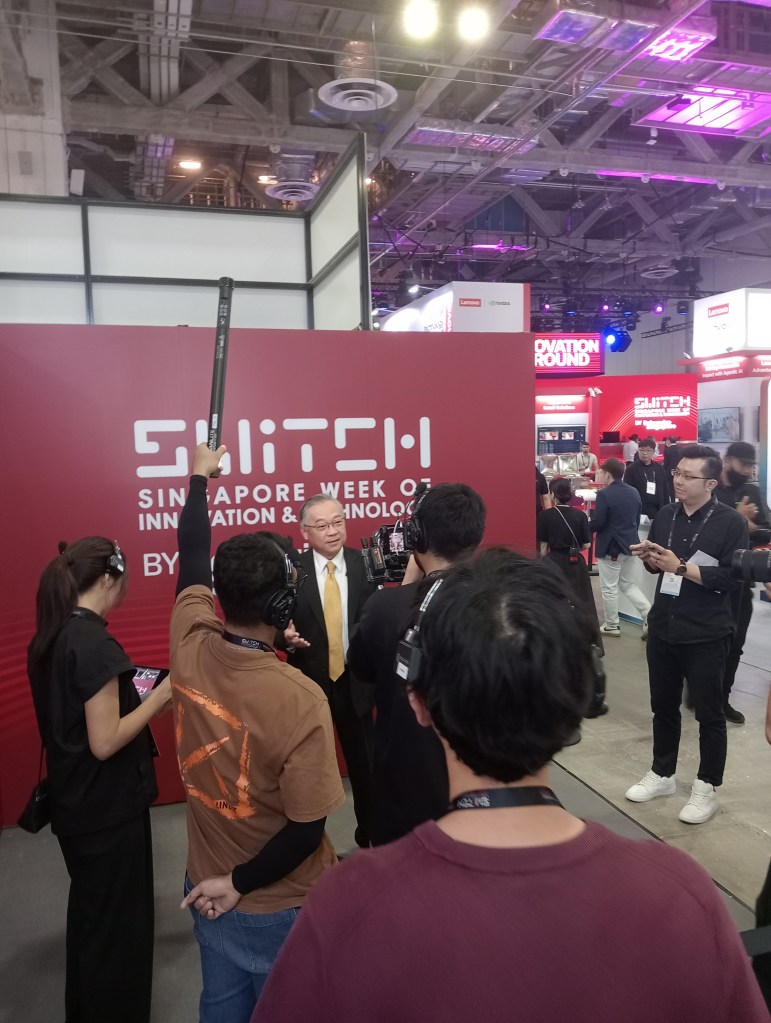
One of the most meaningful moments for me came from an unexpected discovery involving Singapore Airlines.
I learned about the use of Socratic reasoning in pilot training, where pilots are encouraged to develop responses beyond simple yes-or-no answers. The initiative involved collaboration with NUS.
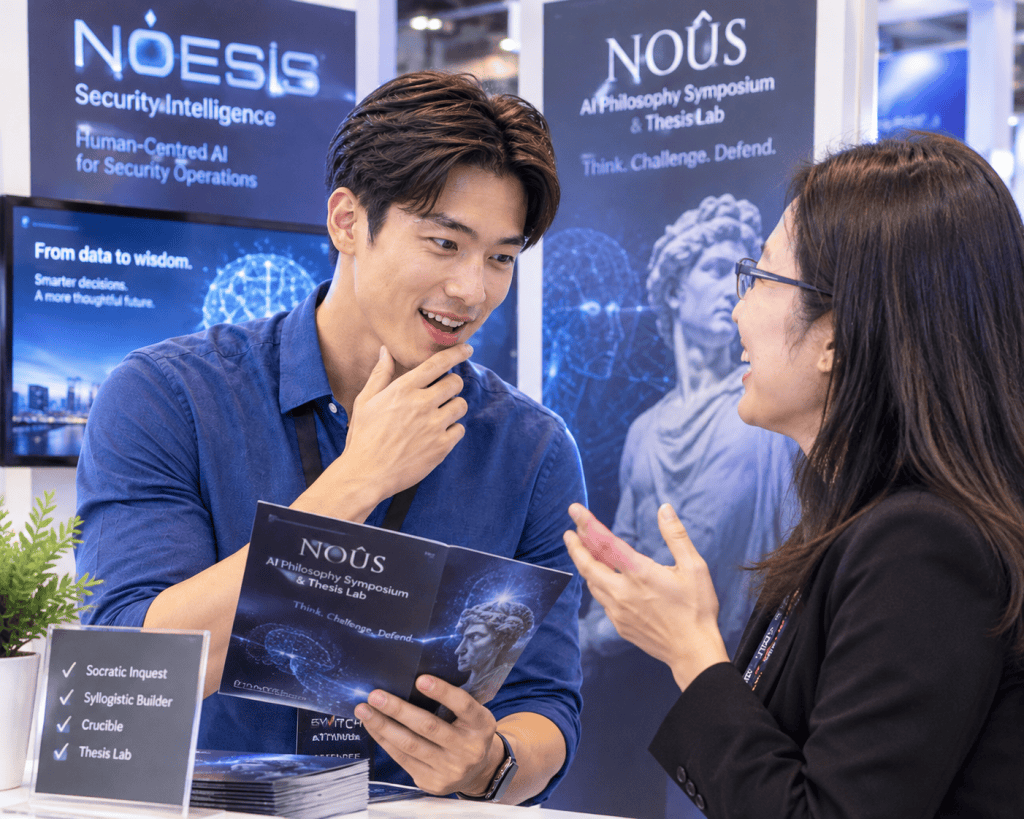
This caught my attention because I had been independently exploring a related idea through my own AI philosophy project, NOÛS.
NOÛS grew out of a question that had increasingly occupied my mind:
If AI can generate an argument for us, can we still defend that argument ourselves?
We live in a time when AI can produce essays, explain complicated concepts, summarise research, and suggest solutions within seconds.
These capabilities are remarkable. But they also raise an important question about how we learn and think.
Are we using AI to strengthen our reasoning, or are we gradually allowing it to do our thinking for us?
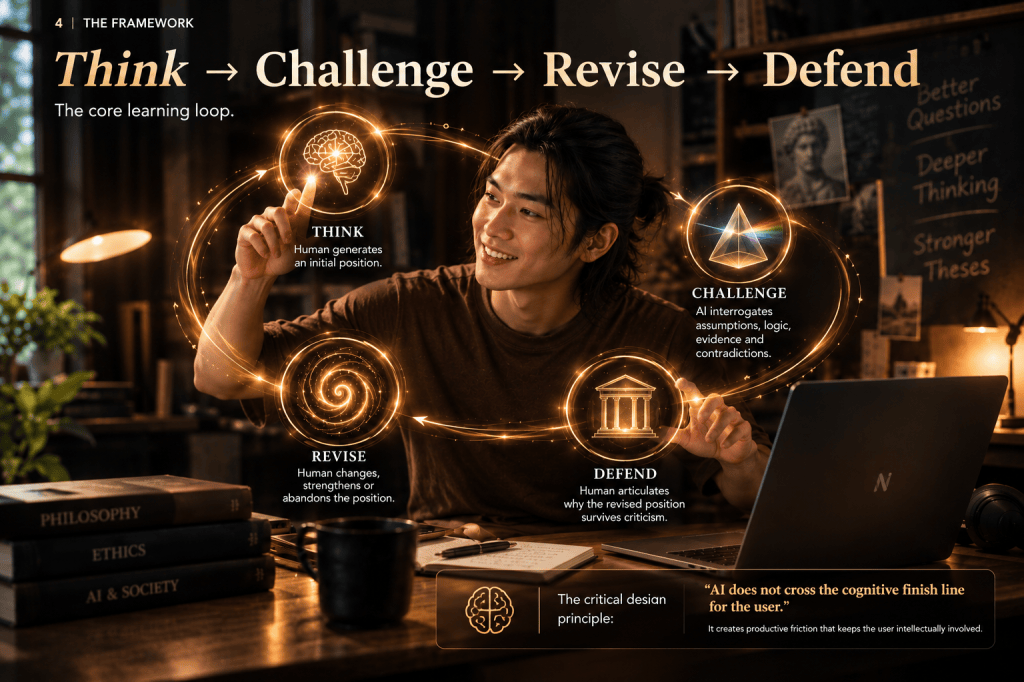
My answer has been to explore AI as an intellectual adversary rather than merely an answer-generating machine.
Through NOÛS, I began developing an approach that encourages people to question, formulate, challenge, revise, and defend their ideas.
The objective is not simply to obtain a convincing answer. It is to develop the ability to examine an argument, recognise its weaknesses, and explain why we believe what we believe.
Discovering an example of Socratic reasoning being applied in an established organisation was therefore a moment of genuine surprise.
I had been developing my ideas independently, drawing from my interests in philosophy, education, and AI. Yet here was an example of related thinking being explored in a practical professional context.
I did not take this as proof that my project was already validated or that the two approaches were identical.
Instead, it opened my eyes to a possibility.
Perhaps the questions I had been exploring through philosophy could have practical applications beyond an educational prototype.
Perhaps the relationship between AI and human reasoning was not merely an abstract philosophical concern. It could also matter in professional training, decision-making, and the development of human capabilities.
That realisation gave me a new perspective on NOÛS.
Rather than seeing it only as a personal experiment, I began thinking more seriously about how it might eventually serve learners, professionals, and organisations.
Sometimes, an idea becomes more meaningful when we discover that the problem behind it matters to people beyond ourselves.
4. Discovering the Connections Between Philosophy, Education, and AI
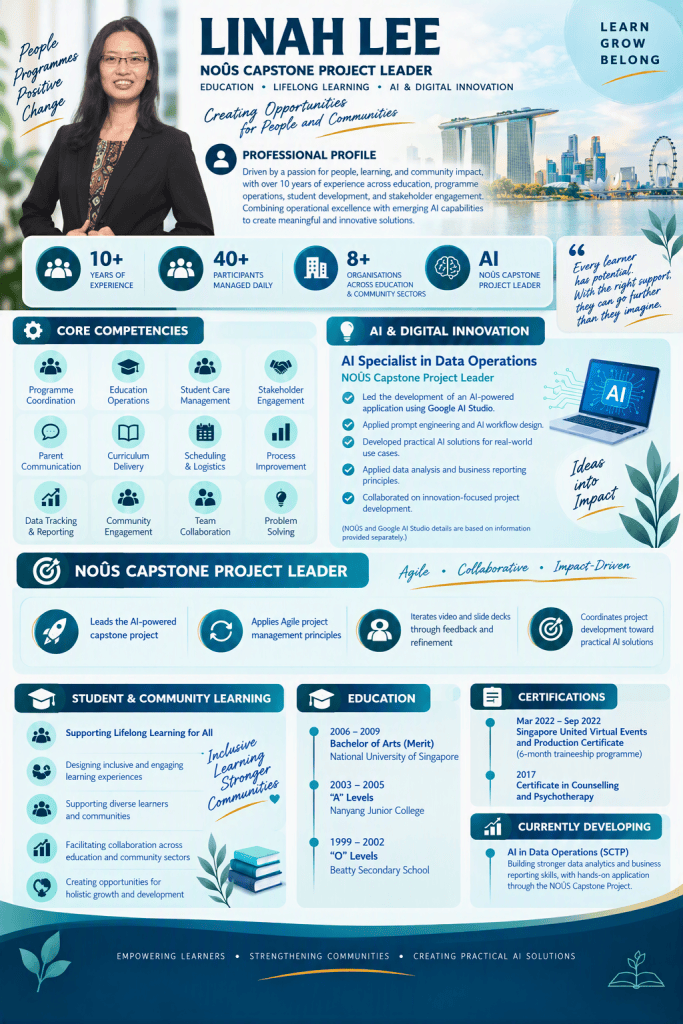
Looking back, I can see that my interest in AI did not emerge in isolation.
My academic background in philosophy taught me to question assumptions and examine ideas carefully.
My years of teaching English helped me appreciate the importance of explaining concepts, guiding learners, and adapting to different ways of thinking.
My counselling and psychotherapy training introduced me to another dimension of human interaction: listening, understanding perspectives, and asking questions that help people reflect.
More recently, my AI Specialist training gave me opportunities to explore how emerging technologies could be applied to practical problems.
For a long time, these experiences might have appeared to belong to different parts of my life.
At SWITCH, I began to see how they could connect.
Philosophy encourages critical thinking. Education helps people develop their capabilities.
Human-centred AI asks us to consider how technology can support people rather than simply automate tasks.
Innovation creates opportunities to bring these ideas into practical settings.
What if my contribution to the AI industry could sit at the intersection of these fields?
I do not necessarily need to become a specialist who spends every working day writing code. Nor do I need to abandon my philosophical interests to pursue a career in technology.
There may be opportunities to help organisations understand their challenges, explore appropriate AI applications, and think carefully about how people will use the solutions being developed.
This is the kind of work I increasingly want to explore.
I am interested in the conversations that happen before a solution is built: understanding a problem, asking the right questions, identifying opportunities, and considering what responsible and useful AI adoption might look like.
I am also interested in what happens after a technology is introduced: whether it genuinely helps people, improves a process, or creates new possibilities.
These questions make innovation exciting to me.
It is not only about the technology itself. It is about connecting technology with human needs.
5. Beyond NOÛS: Exploring NOESIS and Human-Centred AI
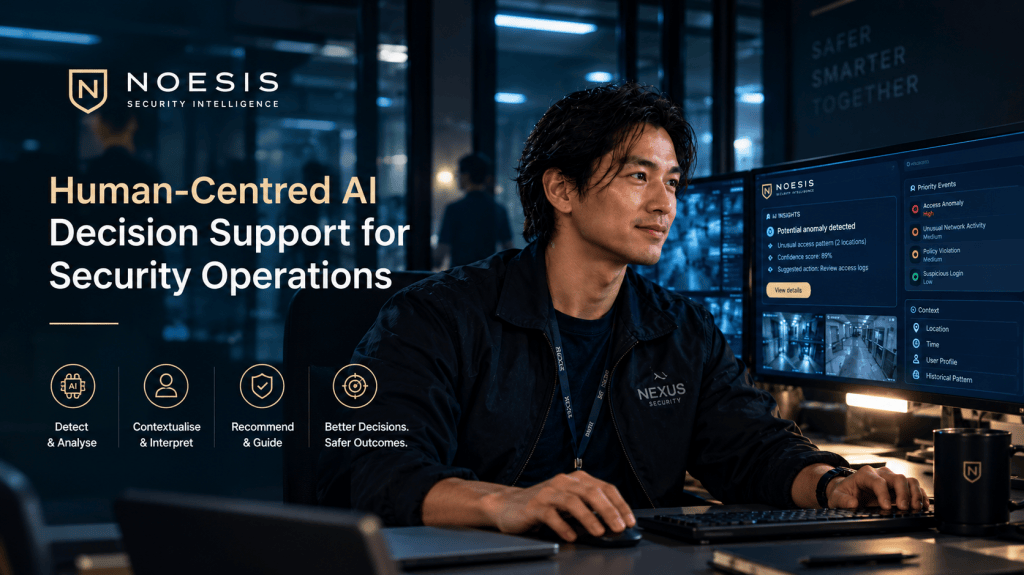
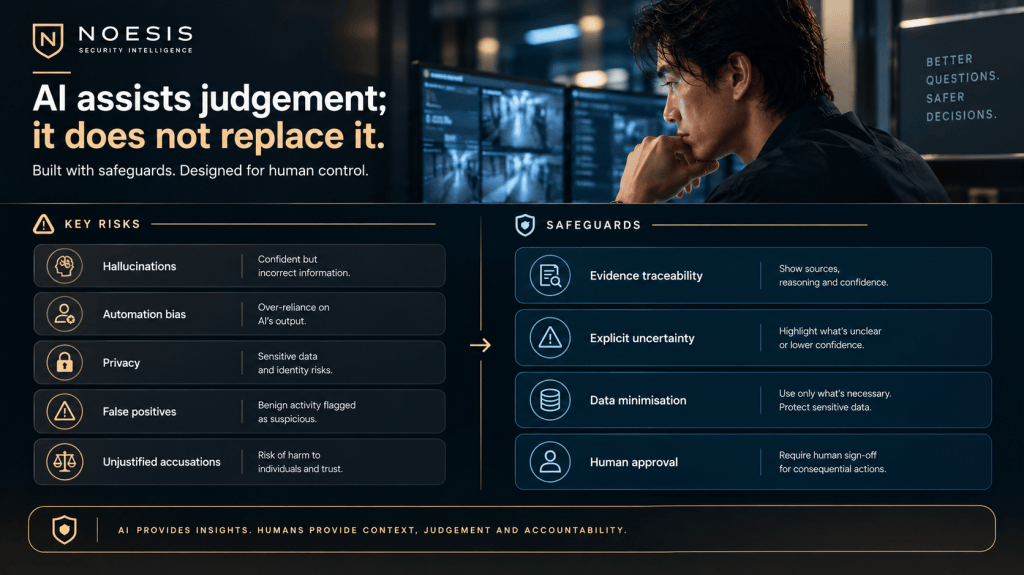
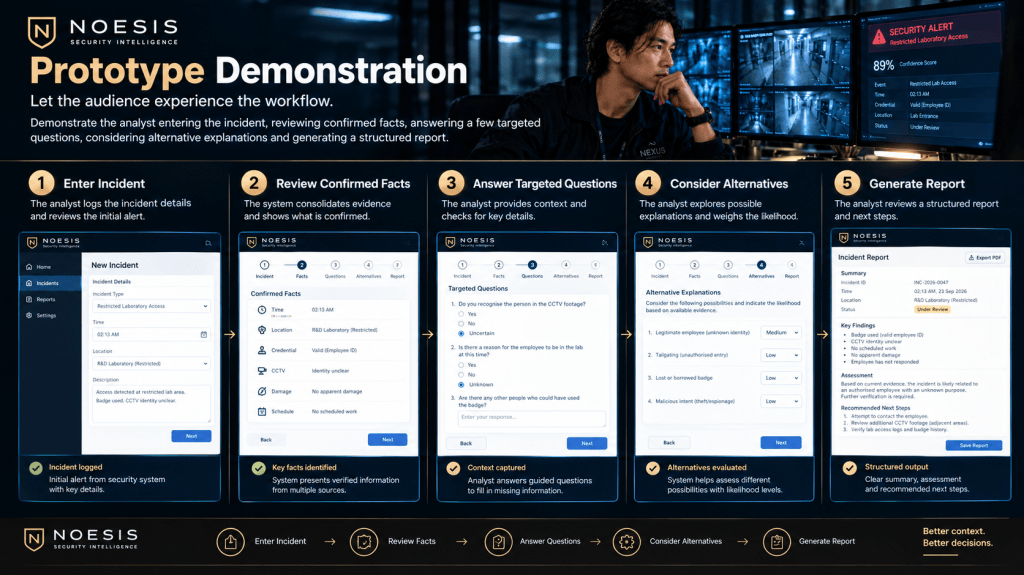
Alongside NOÛS, I have also been developing NOESIS, an exploration of how AI might support security intelligence and human-centred security operations.
Although the two projects approach different problems, they share an underlying interest.
How can AI strengthen human capabilities?
How can we design AI-supported processes that help people think, interpret information, and make better-informed decisions?
And how can we move beyond impressive demonstrations towards applications that are useful in real working environments?
My exploration of NOESIS has encouraged me to think about AI in a more operational context.
Security intelligence, for example, involves more than processing information. People need to interpret what they are seeing, recognise relevant signals, understand context, and decide what to do next.
This makes the relationship between human judgement and AI assistance particularly interesting.
SWITCH gave me an opportunity to look beyond my own projects and consider the broader innovation ecosystem in which ideas like these might develop.
I began to see the value of speaking with organisations, understanding their challenges, and learning how different industries approach technology adoption.
A prototype can begin with an individual idea, but developing something useful may require conversations with potential users, subject-matter experts, collaborators, and organisations willing to explore a problem together.
That is an important next step for me.
I want to continue developing my ideas while learning how to connect them with real-world needs.
I do not need to have every part of the journey figured out today.
I need to keep asking better questions, testing my assumptions, and discovering where my work could be useful.
6. Networking Is Also About Discovering Who You Could Become

One unexpected lesson from SWITCH was that I enjoyed the experience of being there.
I enjoyed exploring the exhibition.
I enjoyed hearing what different organisations were working on.
I enjoyed discovering unexpected connections between ideas.
And I enjoyed having conversations that allowed me to learn about industries beyond my immediate experience.
This prompted me to consider whether I might enjoy a career that involves more of this kind of exploration.
Perhaps I could work in AI innovation, helping organisations identify opportunities for AI adoption.
Perhaps I could explore roles involving AI solutions, business analysis, innovation programmes, or technology partnerships.
Perhaps I could eventually represent my own NOÛS or NOESIS venture, meeting potential collaborators, customers, and investors while learning more about the problems people need solved.
These possibilities are different, but they share a common thread.
They involve curiosity, communication, problem discovery, and connecting ideas with people.
I am drawn to the possibility of being someone who can move between the technical and human sides of AI: someone who understands enough about the technology to explore its potential while remaining attentive to the people and problems behind it.
SWITCH did not give me a definitive career answer.
What it gave me was something equally useful: a better understanding of the kinds of activities that energise me.
Sometimes, we discover our interests by studying them. Other times, we discover them by actually doing them.
For me, speaking with people in the innovation community helped turn an abstract career question into a more tangible possibility.
Instead of asking only, “What job should I apply for?”, I began asking:
What kind of work would allow me to keep learning, exploring, connecting, and building?
That is a more interesting question to carry into my next chapter.
7. Learning to Explore Without Needing to Monetise Everything Immediately
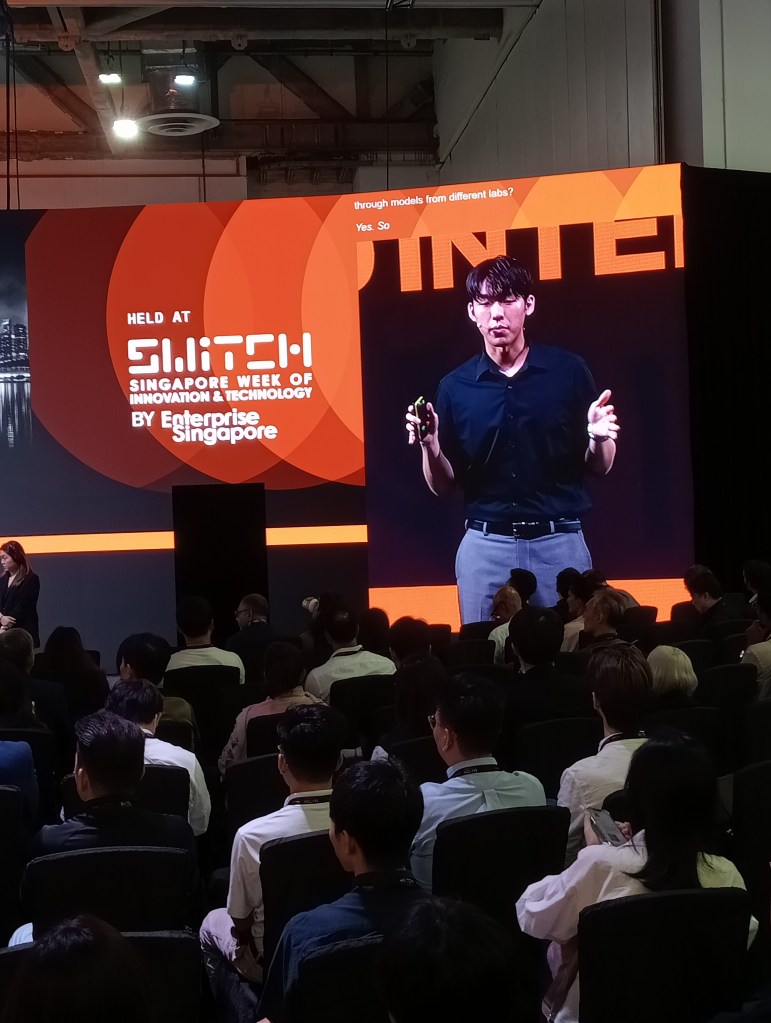
There is another lesson I want to carry forward from this experience.
When developing an idea or considering a career transition, it is tempting to ask whether every activity will produce an immediate result.
Will this conversation lead to a job?
Will this contact become a collaborator?
Will this project generate income?
Will this opportunity lead somewhere definite?
These are reasonable questions, especially when building a sustainable career matters.
But innovation also requires room for exploration.
Not every conversation will lead to a partnership. Not every interesting idea will become a product. Not every event will produce a measurable outcome.
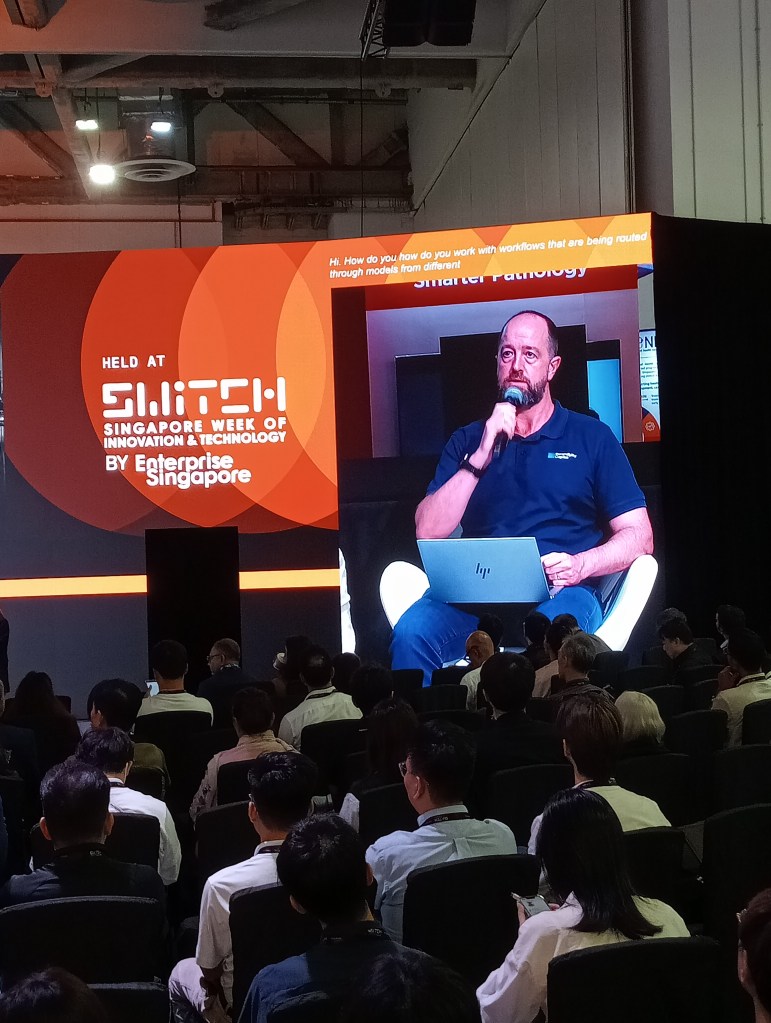
Some experiences help us understand an industry. Others reveal gaps in our knowledge. Some introduce us to people whose work changes how we think about a problem.
Their value may become clearer only later.
For now, I want to continue exploring the AI ecosystem without putting unnecessary pressure on every interaction to produce an immediate result.
I can be intentional about building my career while remaining open to unexpected opportunities.
I can develop NOÛS and NOESIS seriously without demanding that either project become a successful business overnight.
I can learn from people who have already built organisations, products, and professional networks.
And I can allow myself to discover what I am capable of contributing.
This is not about abandoning practical considerations.
It is about recognising that sustainable progress can involve both deliberate action and the freedom to explore.
8. A New Chapter After the Summit
Completing my AI Specialist training marked the end of one demanding season.
Attending SWITCH became part of the transition into another.
During my training, much of my attention was focused on learning new tools, completing assignments, developing projects, and meeting assessment requirements.
At SWITCH, I had a different opportunity.
I could step outside the classroom and explore how technology, business, education, and human capabilities intersect in the wider world.
I could speak with people, observe emerging possibilities, and consider where my interests might lead.
Most importantly, I could begin to imagine a future in which I am not simply learning about AI, but actively contributing to its development and application.
I am still exploring what that contribution will look like.
I may pursue opportunities in AI business analysis, solutions exploration, innovation, or responsible AI adoption. I may continue building NOÛS and NOESIS and seek opportunities to test them with real users. These paths may eventually complement one another.
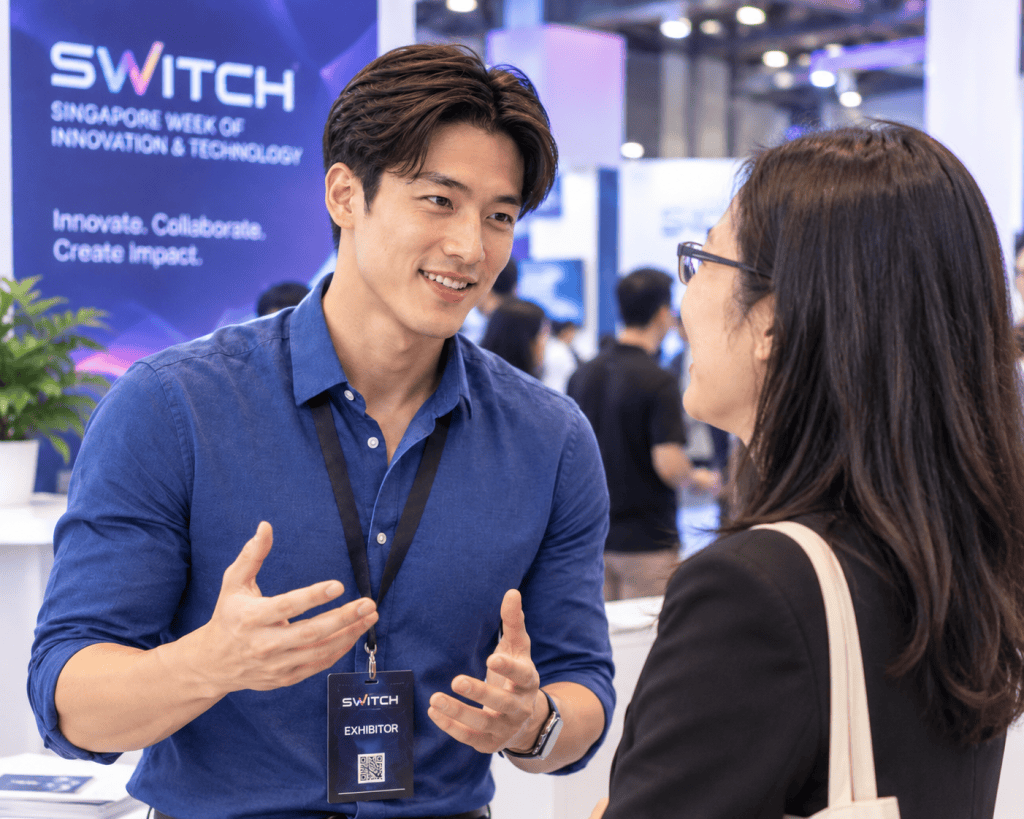
For now, I am learning to take the next step without needing to map out the entire journey.
I am reminded that a career transition is not simply about moving from one job title to another.
It can also be about discovering which parts of our experience are worth carrying forward, which interests deserve more attention, and which environments allow us to contribute meaningfully.
My background in philosophy, teaching, and human development is not separate from my interest in AI.
It may be part of what makes my perspective useful.
And perhaps that is one of the most encouraging things I discovered at SWITCH: I do not have to erase my previous experiences to enter a new field. I can explore how they might become relevant in ways I have not yet imagined.
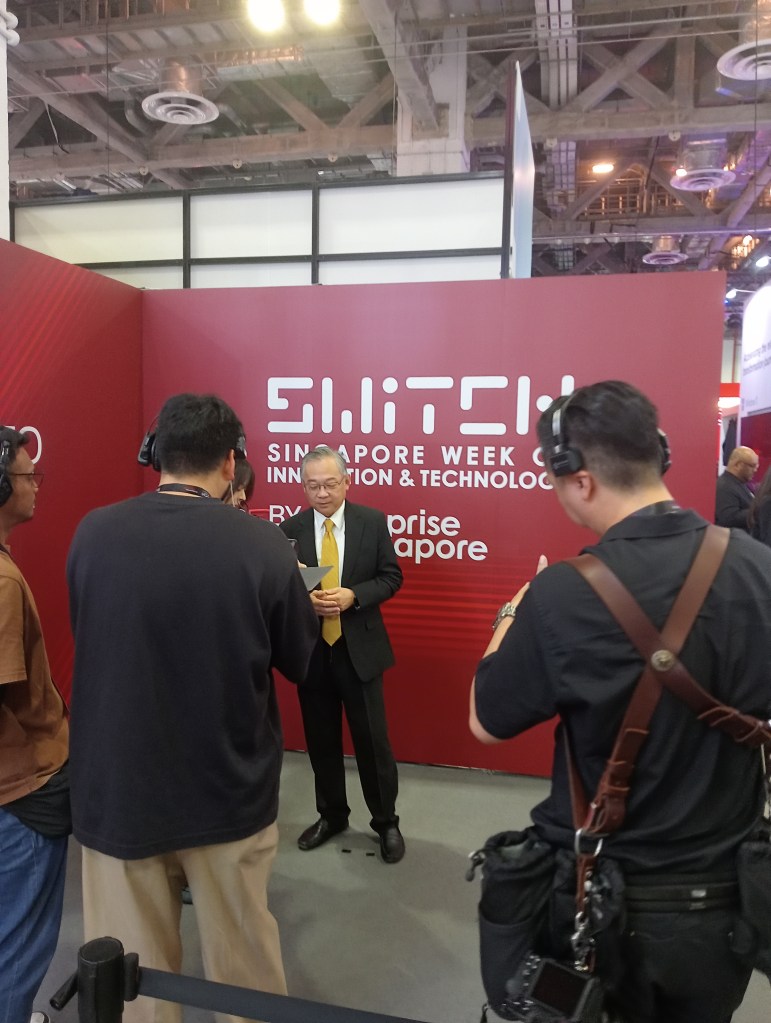
Final Reflection: Sometimes, You Need to Step Into the Room
I attended SWITCH because I wanted to explore the AI and innovation landscape.
I left with more questions, new perspectives, and a stronger sense of the possibilities ahead.
I was reminded that ideas can find unexpected connections in the real world. I discovered that I enjoy conversations about innovation and the challenges organisations are trying to solve. I began to see how philosophy, education, and AI might come together in my future work.
And I realised that sometimes, the next step is not another certificate or another assessment.
Sometimes, it is simply showing up, paying attention, and being willing to start a conversation.
I do not know exactly where NOÛS and NOESIS will lead. I do not yet know which professional opportunity will become the right fit.
But I know that I want to keep exploring.
I want to keep asking questions, developing ideas, meeting people who challenge my thinking, and discovering where human-centred AI can make a meaningful difference.
Perhaps the most important outcome of SWITCH was not finding a single answer.
It was discovering that there are more possibilities worth exploring than I had previously imagined.
And for now, that is enough to begin.
To the next conversation, the next question, and the next possibility.
About my projects
NOÛS explores AI as an intellectual adversary: a way to challenge assumptions, strengthen reasoning, and encourage people to develop arguments they can defend.
NOESIS explores human-centred AI for security intelligence and operational decision-making.
Both projects reflect my broader interest in how AI can support human judgement, learning, and capability development.
As I continue exploring the AI and innovation ecosystem, I hope to connect with people and organisations interested in these questions.
The journey continues.
#SWITCH2026 #ArtificialIntelligence #AILearningJourney #AIInnovation #HumanCentredAI #AITransformation #InnovationEcosystem #FutureOfWork #LifelongLearning #TechForGood #SingaporeInnovation #WomenInAI #AICareerJourney #DigitalTransformation #ResponsibleAI

