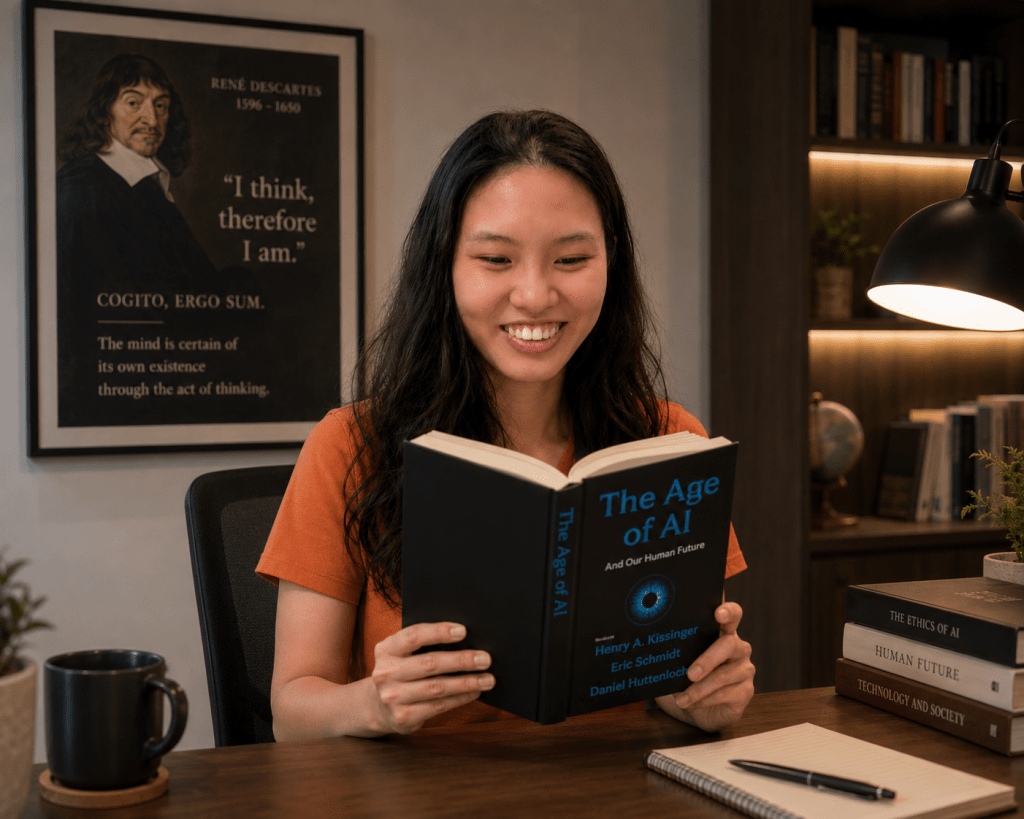
Today I began reading Chapter 1 of The Age of AI: And Our Human Future by Eric Schmidt, Daniel Huttenlocher, and Henry Kissinger.
I expected to learn about artificial intelligence. What I didn’t expect was to revisit one of the greatest philosophers in history—René Descartes.

Descartes is perhaps best known for his famous statement:
“I think, therefore I am.” (Cogito, ergo sum.)
His philosophy marked a turning point in human thought. By questioning everything that could be doubted, Descartes concluded that the one thing he could not doubt was the existence of his own thinking mind. His ability to reason became the foundation of certainty.
Reading this in the context of AI was fascinating.
For centuries, thinking has been one of the defining characteristics of being human. Yet today, we live in a world where machines can write essays, generate images, compose music, solve complex problems, and even engage in conversations that resemble human dialogue.
Naturally, this raises deeper questions.
What does it mean to “think”?
Is intelligence simply computation, or is there something uniquely human that AI cannot replicate?
If machines can reason, what distinguishes human wisdom from artificial intelligence?
These are no longer just philosophical questions. They are becoming practical questions for leaders, educators, policymakers, and anyone living in an AI-powered world.
As someone who is just beginning my AI learning journey, I appreciate that this book doesn’t start with technology alone. Instead, it begins by exploring the ideas that have shaped how humanity understands knowledge, reason, and intelligence.
It reminds me that learning about AI isn’t just about understanding algorithms. It’s also about understanding ourselves.
Perhaps that’s why philosophy still matters.
As AI continues to evolve, the question may not simply be what machines can do, but what it truly means to be human.
I’m looking forward to continuing this journey—one chapter at a time.
 All about Lina Lifestyle