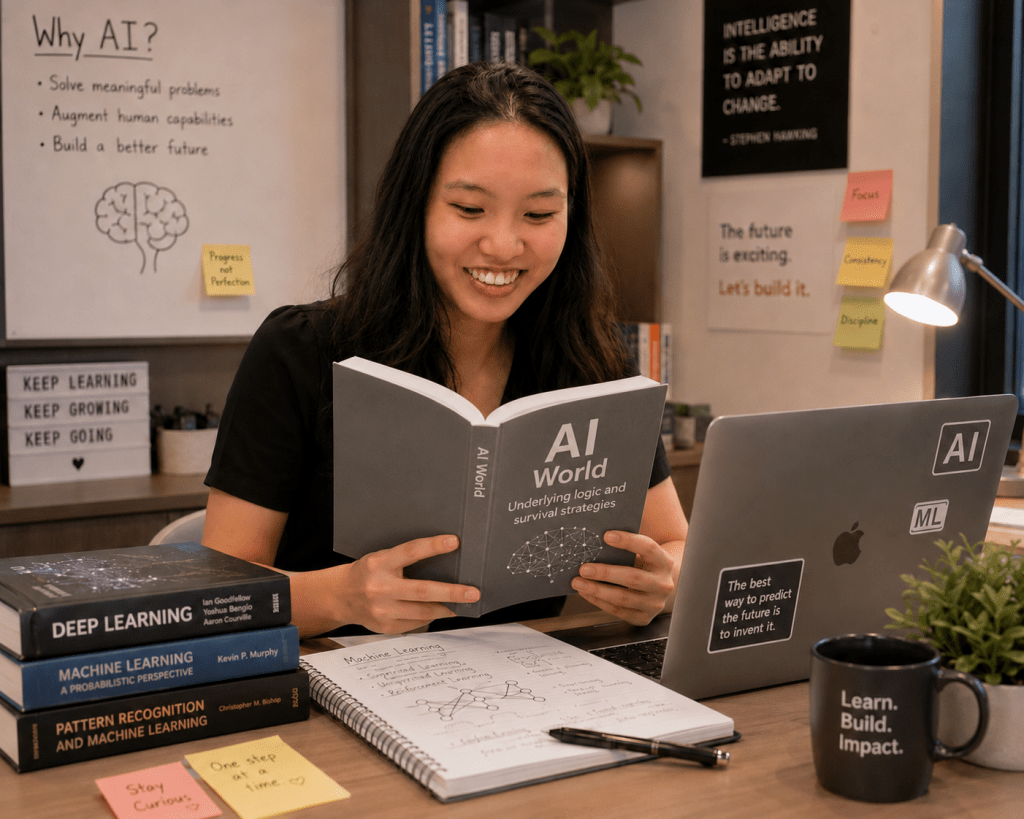
One idea from AI World: Underlying Logic and Survival Strategies by Sega Cheng has stayed with me long after I put the book down:
As AI becomes routine, the demand for the humanities grows.
At first glance, it sounds paradoxical.
We’re surrounded by headlines urging us to learn AI, master prompt engineering, or become proficient in the latest tools. The prevailing narrative suggests that technical expertise alone will define success in the future.
But what if the opposite is also true?
The Commoditization of Technical Tasks
Artificial intelligence is rapidly becoming part of everyday work. It can draft emails, summarize reports, write code, analyze data, translate languages, and generate creative content in seconds.
As these capabilities become more accessible, technical tasks that once required specialized knowledge are increasingly becoming commodities. AI doesn’t eliminate the need for expertise, but it changes where human value lies.
The question shifts from “Can you produce?” to “Can you decide what should be produced?”
That distinction is significant.
Why the Humanities Matter More Than Ever
The humanities—history, philosophy, literature, psychology, ethics, and the arts—teach us to think beyond facts and algorithms.
They help us:
- Ask thoughtful questions instead of accepting easy answers.
- Understand different perspectives and cultures.
- Navigate ethical dilemmas.
- Communicate with empathy and clarity.
- Interpret context and ambiguity.
- Exercise judgment when there is no obvious solution.
These are not simply “soft skills.” They are enduring human capabilities that become increasingly valuable as AI handles more routine cognitive work.
AI Can Generate Answers, But Humans Define Meaning
AI is remarkably good at recognizing patterns and generating responses based on data.
What it cannot truly do is understand human purpose in the way people do.
When leaders decide how AI should be used, they face questions that cannot be answered by algorithms alone:
- Should this decision be automated?
- Is it fair?
- Who benefits?
- Who could be harmed?
- What values should guide us?
These are questions rooted in ethics, philosophy, and human experience.
The Future Belongs to Hybrid Thinkers
I don’t believe the future belongs exclusively to technologists or humanities graduates.
It belongs to people who can bridge both worlds.
People who understand technology while appreciating human behavior.
People who can analyze data without losing sight of empathy.
People who combine logic with wisdom.
Technical skills help us build intelligent systems. The humanities help us build systems worth trusting.
A Personal Reflection
Reading this idea challenged one of my own assumptions.
Like many people, I initially thought succeeding in the AI era meant constantly learning new tools. While that remains important, I’ve come to realize that my greatest investment may not be another software certification or programming language.
It may be spending more time reading history to understand societal change.
Studying philosophy to sharpen ethical reasoning.
Exploring psychology to better understand people.
Reading literature to develop empathy.
These disciplines cultivate habits of thinking that AI can support but not replace.
Final Thoughts
As AI becomes an everyday utility—much like electricity or the internet—its novelty will fade. What will continue to differentiate individuals and organizations is not merely access to AI, but the wisdom to use it well.
Perhaps the most valuable skill in the age of artificial intelligence is not becoming more like a machine.
It is becoming more deeply human.
Technology will continue to evolve. The qualities that define humanity—curiosity, compassion, judgment, creativity, and ethical responsibility—will remain timeless.
In the end, AI may change how we work, but the humanities remind us why we work and who we serve.
 All about Lina Lifestyle