There’s a particular kind of dream that doesn’t feel random.
Not the chaotic kind where you suddenly forget your pants during an exam while being chased by a giant hamster. These dreams feel curated. Lit carefully. Emotionally coherent. Like your subconscious rented out an abandoned cinema and started screening films made entirely out of atmosphere.
That’s what happened during my three days of medical leave.
Every morning, I woke up carrying fragments of entire worlds.
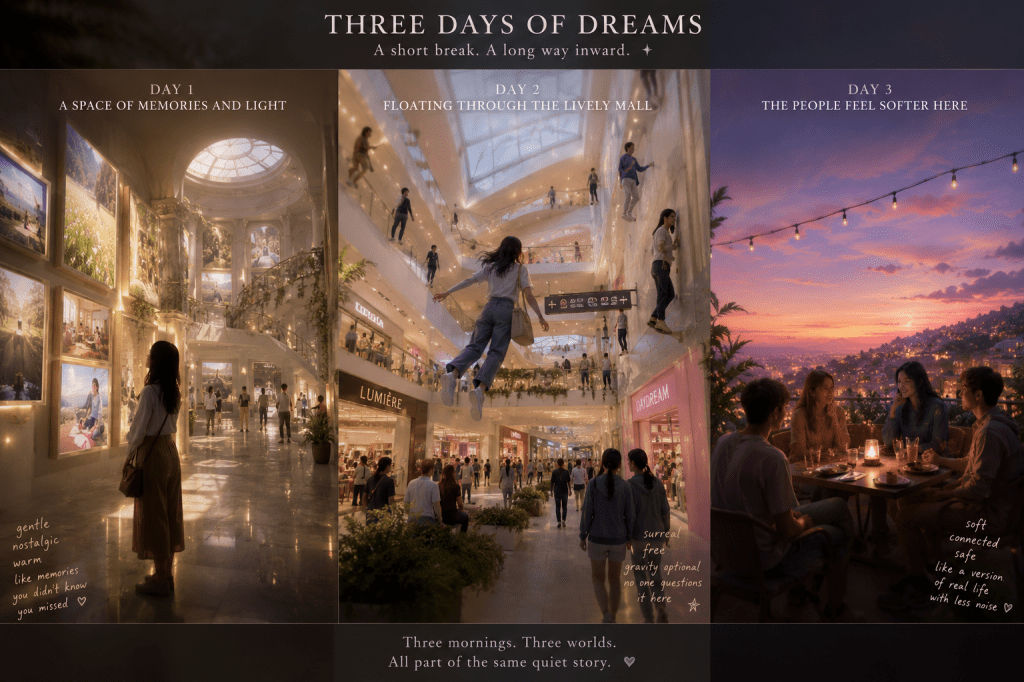
One dream took place inside what felt like a museum made of memories and light. Another unfolded in a shopping mall where people casually climbed walls and drifted vertically through open spaces, as if gravity had become more of a suggestion than a law. Nobody questioned it. Nobody panicked. The impossible simply existed alongside fluorescent storefronts and soft conversation.
And somehow, that made it feel more real.
The strange thing about surreal dreams is that they rarely announce themselves as surreal. Dreams don’t usually scream Look how weird this is! Instead, they gently rewrite reality and wait for you to accept it. Your brain says: yes, naturally people move vertically here. Of course this corridor bends into another memory. Of course the air itself feels golden.
That emotional logic matters more than physical logic.
What stayed with me wasn’t just the imagery — it was the tone. Every dream carried the same emotional texture:
- calm
- spacious
- socially gentle
- nostalgic
- quietly unreal
None of them felt threatening. They felt contemplative. Like places designed for wandering rather than escaping.
I started wondering why these dreams appeared so intensely during medical leave. Then it clicked: for the first time in a while, my mind had room.
Daily life compresses attention into survival mode. Wake up. Reply. Travel. Work. Perform. Repeat. Even rest becomes scheduled. But medical leave interrupted the machinery. My routines dissolved for a few days, and suddenly my brain no longer had to spend every ounce of energy managing the external world.
So it turned inward.
Sleep probably played a role too. Waking up naturally in the morning often means waking directly out of REM sleep — the phase most associated with vivid dreams. Without alarms tearing the experience apart, the dreams stayed intact long enough to remember.
But I think it went deeper than biology.
The dreams felt less like random neural static and more like emotional processing rendered as architecture.
A memory museum.
A gravity-defying mall.
Softly altered social spaces.
Worlds where ordinary rules loosened without collapsing completely.
It felt like my subconscious was experimenting with freedom in small, gentle ways.
Even the lighting in the dreams seemed emotionally deliberate. Everything carried that early-Saturday softness — the kind of brightness that feels warmer than reality itself. Not cinematic in a dramatic sense. More like reality with the emotional sharp edges sanded down.
And maybe that’s what rest actually does when we finally allow it to happen.
Not just physical recovery, but psychological decompression.
Sometimes the mind doesn’t respond to rest with silence. Sometimes it responds with creativity. With symbolism. With impossible malls and drifting bodies and memory archives glowing softly in the distance.
Maybe dreams become vivid during moments like these because the brain finally has enough quiet to speak in its native language: images, spaces, feelings, strange physics, emotional weather.
For three mornings, my subconscious became a filmmaker.
And honestly?
The films were beautiful.
 All about Lina Lifestyle