Late morning dreams feel different from night dreams.
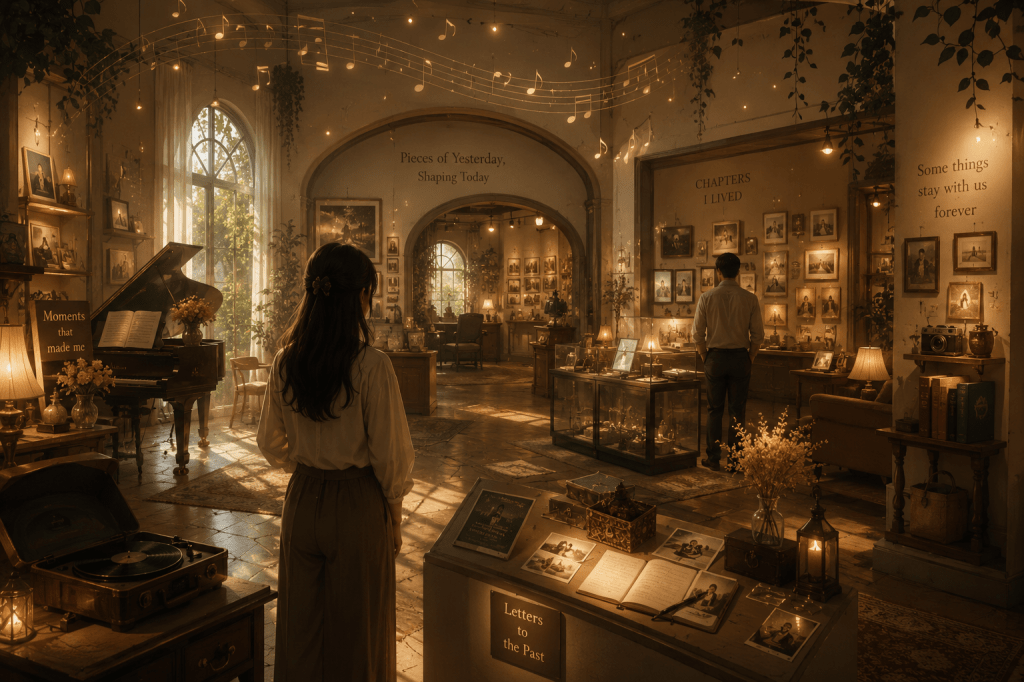
They arrive softer, slower, almost aware that the body is half-awake. Light leaks through the curtains. The world outside already exists again, but the mind still refuses to leave its private theater. That was where I found myself on the third day of medical leave — wandering through a place that felt less like a dream and more like a carefully curated memory exhibit.
It was a living space, but not entirely a home.
It resembled a museum assembled by someone sentimental and meticulous. Every room carried the atmosphere of preserved time. Nothing looked abandoned. Nothing looked futuristic either. The entire place felt suspended between eras, as though memories themselves had become furniture.
There were objects whose meanings I somehow understood without explanation. Corners illuminated by warm light. Hallways that invited wandering instead of destination. Shelves and spaces arranged with the quiet confidence of someone trying to honor the past without disturbing it.
And throughout it all, music played.
Not loudly. Not dramatically.
Pleasant melodies drifted through the rooms like invisible threads stitching the dream together. The kind of music that makes nostalgia feel gentle instead of painful. It didn’t command attention; it accompanied existence. Every step through the museum-like space felt synchronized to those melodies, as if the dream itself had a soundtrack composed from forgotten feelings.
What fascinated me most was the role I occupied in the dream.
I wasn’t merely visiting the place.
I was curating it.
Moving through the rooms carried a strange sense of responsibility, as though I had personally selected what deserved preservation. Not just objects, but emotions. Atmospheres. Versions of time. It felt like constructing a sanctuary from fragments of memory — a place where moments could continue existing safely, untouched by reality’s tendency to move on too quickly.
And somewhere within that dream, a colleague appeared.
Not intrusively. Not symbolically obvious in the way movies often portray dreams. Their presence felt natural, almost observational, like another person quietly walking through the museum alongside me. Neither stranger nor central figure. Just someone existing within the emotional architecture of the space.
Dreams are strange that way.
Sometimes the people who appear are not there because of who they literally are, but because of what period of life they belong to. Perhaps my mind simply borrowed a familiar face from my current reality and placed it among older emotional landscapes. Or perhaps the dream was trying to connect my present life with memories I haven’t fully unpacked yet.
Medical leave changes the rhythm of consciousness.
Routine dissolves. Time stretches differently. Without deadlines and constant motion, the mind begins opening storage rooms usually kept locked during ordinary days. Maybe that is what the dream really was: not fantasy, but internal archival work. A quiet act of emotional preservation occurring beneath waking thought.
What remains with me after waking is not confusion, but atmosphere.
The warmth of the lighting.
The softness of the melodies.
The feeling of walking through memory without fear.
For a few suspended moments late that morning, my sleeping mind built a museum where the past was not something haunting, but something lovingly arranged.
 All about Lina Lifestyle