In my last reflection, I wrote about the cocoon season—the hidden places where God quietly dismantles old identities, old expectations, and even old versions of ourselves so that something deeper can emerge.
But what I’ve come to realize is this:
The cocoon is not the end of transformation.
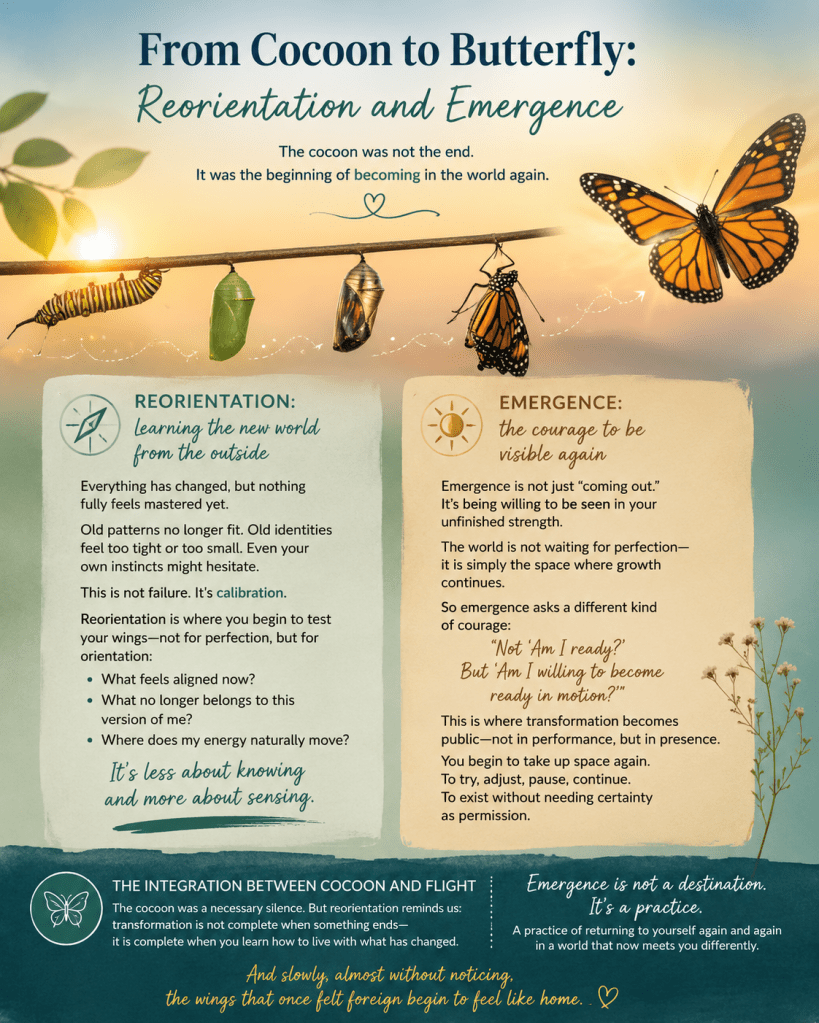
It is only the beginning of reorientation.
Because emerging from the cocoon does not immediately feel like freedom. Sometimes it feels unfamiliar. Sometimes it feels disorienting. Sometimes the very thing you prayed for arrives, and yet you still find yourself asking:
Who am I now?
The butterfly does not emerge flying.
It emerges fragile. Soft-winged. Learning gravity again.
And maybe that is where many of us are right now spiritually, emotionally, even vocationally—not fully hidden anymore, but not yet fully steady in the newness God is unfolding.
“See, I am doing a new thing! Now it springs up; do you not perceive it?” — Isaiah 43:19
I think reorientation is the part we rarely talk about.
We celebrate breakthrough. We celebrate arrival. We celebrate transformation stories once they sound complete.
But Scripture is filled with people who had to learn how to live after transition.
Moses had to reorient from prince to shepherd.
David from shepherd to king.
Peter from fisherman to disciple.
Paul from persecutor to apostle.
God changed their direction before He fully revealed their destination.
And perhaps that is why reorientation feels uncomfortable: because faith often requires movement before mastery.
“For we walk by faith, not by sight.” — 2 Corinthians 5:7
There is a holy tension in becoming.
Old patterns no longer fit. Old instincts no longer lead with the same certainty. Even the spaces that once felt familiar can begin to feel too small for who God is shaping you to become.
Not because you are lost.
But because you are stretching.
Because growth often feels awkward before it feels natural.
The butterfly emerging from the cocoon must strengthen wings it has never used before. Likewise, God sometimes calls us into capacities we have never had to rely on before—deeper trust, deeper surrender, deeper dependence on Him.
And that dependence changes us.
“Trust in the Lord with all your heart and lean not on your own understanding.” — Proverbs 3:5
I am learning that emergence is not about becoming perfect.
It is about becoming willing.
Willing to be seen again.
Willing to move again.
Willing to trust God outside the cocoon.
Because hiddenness can become strangely comfortable. Safe. Predictable.
But we were not created to remain inside places that were only meant to transform us.
At some point, the cocoon that protected us can also become the thing that restricts us.
And so God calls us outward.
Not rushed. Not forced. But invited.
Invited into visibility.
Invited into obedience.
Invited into new terrain.

“Arise, shine, for your light has come…” — Isaiah 60:1
What encourages me most is knowing that God does not abandon us between transition and arrival.
He is present in the hidden formation.
Present in the uncertainty of reorientation.
And present in the trembling first movements of emergence.
The butterfly does not question whether it was created to fly. It simply grows into what was already written within it.
Maybe faith is similar.
Maybe becoming is less about striving to invent ourselves and more about surrendering to who God has already been forming beneath the surface all along.
And slowly—sometimes so slowly we barely notice—what once felt unfamiliar begins to feel like grace.
The wings strengthen.
The movement steadies.
The fear loosens.
And what once felt like an ending becomes the beginning of learning how to live transformed.
 All about Lina Lifestyle