Reading a storyline can sometimes be difficult for young learners as there are many characters to follow and often times they are daunted by unfamiliar vocabulary. As a result, having to think about the answers for both literal and inferential questions can be cognitively challenging if one finds it hard to understand the story. In my previous article on educational psychology I shared about scaffolding. A method of scaffold will be the use of comics.
Viewing comics build confidence
Using comics can build up confidence in one’s ability to know the plot when the visuals are centered on the characters journey. This enables the reader to see how the character develops frame by frame and be able to follow the plot from the beginning to the end. Hence this lead to a build up of confidence when they can achieve more clarity in understanding the text. This psychological confidence shows the character coming to life in a vivid manner allowing them to follow the intricate plotline with precision and accuracy which is critical for the task of understanding what the question requires.
Character Development
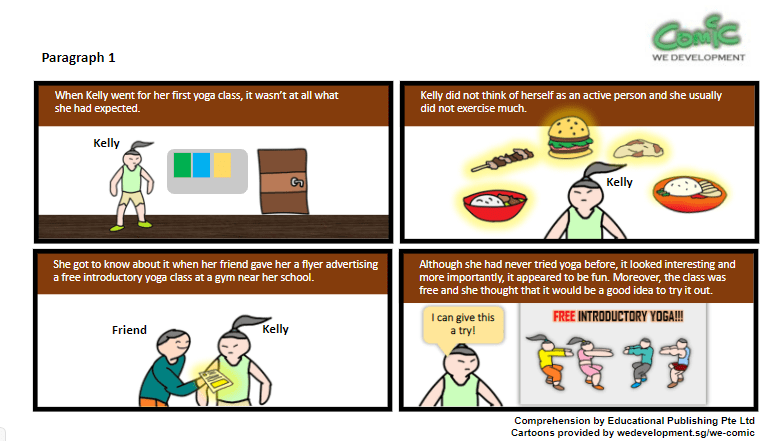
The Comic creator WE development started with illustrating the first paragraph. We can see how the plot begins with the character Kelly and what are the reasons for her actions coherently and clearly. These frames help to break down large chunks of information to smaller bite size information where we can follow what Kelly thinks, feels or acts.
Question 1 (Literal)
Question: Why did Kelly decide to give yoga class a try?
Answer: Kelly decided to give the yoga class a try because she thought it was engaging and enjoyable.
The answer is taken from paragraph 1. By referring to the comics in the fourth frame we can locate the sentence, “Although she had never tried yoga before, it looked interesting and more importantly, it appeared to be fun.”
This literal question requires one to give the correct reason for Kelly’s decision to try yoga. The question requires one to know how to locate the answer from the text. The sentence gives the contextual clue “she had never tried yoga”. Once we know that Kelly had never tried yoga hence we can arrive at the answer where Kelly decided to give the yoga class a try.
Next, it is important to show understanding of the meaning of “interesting” and “fun”. By using another word that is synonymous with interesting we get the word engaging. Another word synonymous with fun will be enjoyable. We arrive at the reason behind why Kelly decide to give yoga class a try “because she thought it was engaging and enjoyable”.
Sometimes, learners can get confused with locating the right answer as they may read the second frame. This is where the sentence “Kelly did not think of herself as an active person and she usually did not exercise much” can be incorrectly identified as the answer. The question requires one to answer why she decided to “act” rather than what Kelly thought. Thus, it is good to use the comics to refer back to the question requiring us to locate the right contextual clue that answers the question more appropriately.
Question 2 (Inferential)
Why do you think Kelly enquired about membership?
Kelly was interested in the gym’s class and may be thinking about joining the gym as a member.
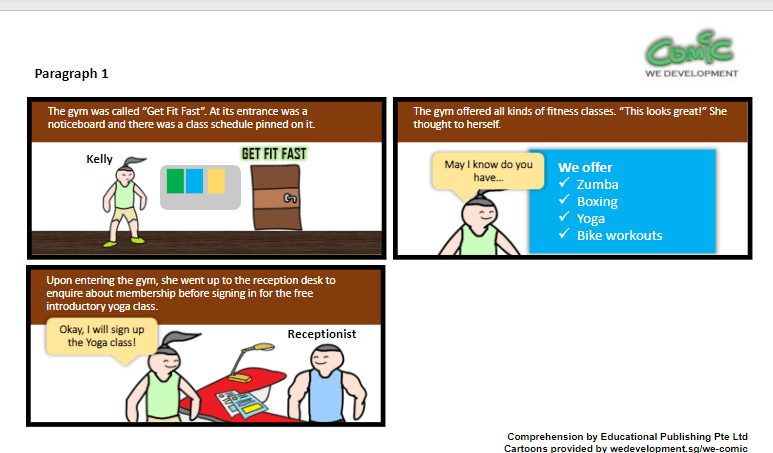
The answer is taken from the sentence “This looks great!” she thought to herself. Upon entering the gym, she went to the reception desk to enquire about membership before signing in for the free introductory class. In the next three frames we can follow Kelly’s journey to the gym class and view her encounter with another character in the story.
This is an inferential question where information on the yoga class is not made apparent to Kelly and she has to ask the receptionist in order to find out more about the membership. To arrive at the answer, we can infer that Kelly is “interested” in the class from the contextual clue “This looks great!”. We can also infer from “enquire about membership” that she may be thinking about joining the gym as a member.
Question 3 (Inferential)
What did Kelly notice about the room when she first entered?
She noticed the size of the classroom and the aromatherapy diffuser that filled the classroom with the fragrance of lavender/the calming music that was playing from the speakers.
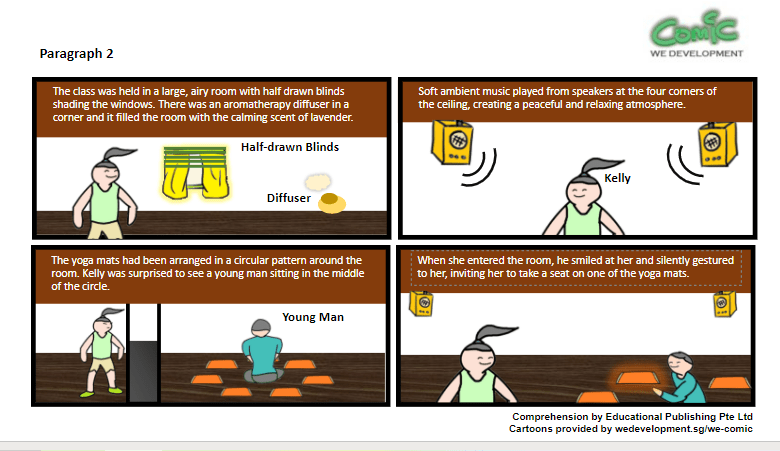
The first part of the answer is taken from the sentence “The class was held in a large, airy room with half-drawn blinds shading the windows. There was an aromatherapy diffuser in a corner and it filled the room with the calming scent of lavender.”
First, we arrive at “noticed the size of the classroom” from the relevant part of the sentence giving the contextual clue “large, airy room”. The size of the classroom is described as large and airy hence it is relevant to the question on what she noticed using her sense of sight about the room.
Second, there was an aromatherapy diffuser in a corner that filled the classroom with the fragrance of lavender. Kelly noticed the scent of lavender using her sense of smell and hence we get “the fragrance of lavender” in the sentence.
Third, we can also get “calming music that was playing from the speakers”. The contextual clue will be “soft ambient music played from speakers at the four corners”. Kelly noticed the speakers playing calming music using her sense of hearing.
 All about Lina Lifestyle