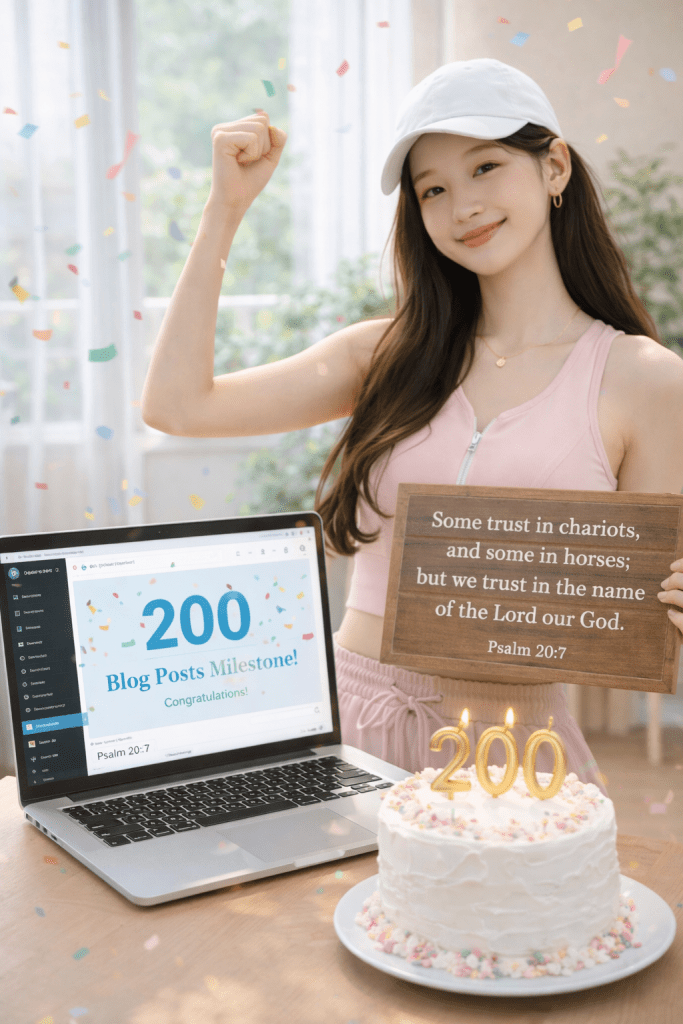
📖 “Some trust in chariots, and some in horses;
but we trust in the name of the Lord our God.” — Psalm 20:7
Two hundred posts.
That’s not just a number. That’s years of showing up. Of writing when inspiration flowed — and when it didn’t. Of publishing thoughts that felt polished, and others that felt vulnerable. Of pressing “publish” not knowing who would read, who would resonate, or who would scroll past.
Two hundred posts is visible work.
But Psalm 20:7 reminds me that visible work is not the same as ultimate trust.

Chariots, Horses — and Modern Metrics
In the ancient world, chariots and horses were military assets. They represented speed, power, strategic advantage. If you had them, you were formidable. If you didn’t, you were vulnerable.
Today, our “chariots and horses” look like:
- Page views
- Follower counts
- Engagement rates
- SEO rankings
- Shares and reposts
They are measurable. Impressive. Quantifiable.
And subtly, they can become where we place our trust.
After 200 blog posts, it’s easy to ask:
Did they perform well?
Did they grow my platform?
Did they build influence?
But Psalm 20:7 draws a line in the sand.
Some trust in performance.
Some trust in visibility.
But we trust in the name of the Lord our God.
What Does It Mean to “Trust in the Name”?
The verse doesn’t just say “trust in God.” It says trust in the name of the Lord.
In Scripture, a name represents character — essence — reputation. To trust in His name is to trust in who He has revealed Himself to be: faithful, just, compassionate, sovereign.
It means believing that:
- Obedience matters more than applause.
- Faithfulness matters more than fame.
- Integrity matters more than influence.
Two hundred posts are the work of my hands.
But the outcome of that work belongs to Him.
Writing as Worship
Over the years, blogging has become more than content creation. It has become discipline. Reflection. Sometimes confession. Sometimes encouragement.
There were posts written in clarity.
Posts written in uncertainty.
Posts written after mountaintop moments.
Posts written in wilderness seasons.
Psalm 20 was originally a prayer for victory before battle. The people would ask God to grant success — not because of their weapons, but because of His covenant faithfulness.
In many ways, every time we publish something, we step onto a battlefield of comparison, competition, and self-doubt. The temptation is to rely on our skill, our strategy, our creativity alone.
But the deeper prayer is this:
Lord, establish the work — not because it is impressive, but because it is offered to You.
When the Numbers Rise — and When They Don’t
Verse 8 continues:
“They collapse and fall, but we rise and stand upright.”
Chariots fail. Horses tire. Metrics fluctuate. Platforms change. Algorithms shift.
But trust anchored in God stands steady.
If 200 posts taught me anything, it’s this:
Consistency built discipline.
Discipline built clarity.
Clarity built conviction.
And conviction does not depend on applause.
The Next 200
As I look ahead, the question is no longer, “How do I grow this?”
The question is, “How do I remain faithful?”
May the next 200 posts be written not in pursuit of visibility, but in pursuit of truth.
Not to accumulate influence, but to cultivate impact.
Not to trust in digital chariots and horses — but in the Lord who sustains the writer behind the screen.
Because in the end, platforms fade.
But faithfulness endures.
Returning to the Promised Land: Trusting God When Practice Is Harder Than Theory
After a long rest, the return feels sharper.
The promised land is no longer an idea. It is a workplace. Responsibilities. Conversations. Expectations. The very place that once felt like answered prayer now demands something of you.
And if I’m honest, Psalm 20:7 is easier to quote than to live.
When the Promised Land Feels Pressured
There was a time when the promised land was simply hope — something prayed for, waited on, longed toward. But once you are in it, the terrain changes. The stakes feel higher. The performance feels visible.
The “chariots and horses” here are subtle:
- Competence
- Reputation
- Results
- Approval
It is tempting to lean on skill, preparation, experience — to trust in what I can manage.
Yet Psalm 20:7 interrupts that instinct.
It does not condemn effort.
It reorders trust.
The verse doesn’t say chariots are useless. It says they are not ultimate.
And that is where practice becomes difficult.
The Gap Between Knowing and Trusting
I know the theology. I know the right language. I know that my security is in God’s name — His character, His faithfulness, His sovereignty.
But in the moment — when deadlines approach, when decisions carry weight — my reflex is still self-reliance.
Trusting in the name of the Lord means:
- Working diligently, but not anxiously.
- Preparing thoroughly, but not obsessively.
- Accepting outcomes without letting them define me.
It sounds simple. It is not.
Faith in theory is calm.
Faith in practice is surrender.
Rest Reveals What We Really Trust
Interestingly, the long rest was easier than the return.
During rest, trust feels natural. There is space to pray, reflect, breathe. The absence of pressure makes faith feel steady.
But returning to work reveals what anchors me.
Rest gave clarity.
Work tests it.
And yet, the long rest was not wasted. It strengthened something quiet inside — perspective. A reminder that I am more than output. That I can step away and still be held.
Perhaps that is part of trusting in the Lord’s name: believing that He sustains me in stillness and in striving.
Trusting Differently This Time
Going back to the promised land does not mean charging in with chariots blazing.
Maybe it means walking in with quieter confidence.
Not proving.
Not performing.
Not grasping.
But trusting.
Psalm 20:7 is not a denial of effort. It is a declaration of foundation.
I will use the tools given to me.
I will work with excellence.
But I will not anchor my identity in outcomes.
Because if the promised land is truly promised, then it is sustained not by my horsepower — but by God’s faithfulness.
A Prayer for the Return
Lord,
As I return to the work You have allowed me to enter,
guard my heart from trusting in visible strength alone.
Help me to practice what I profess.
Let my confidence rest in Your name —
not in my competence.
Thank You for the long rest that restored me.
Now teach me to carry that rest into the work.
Amen.
Maybe this is what maturity looks like — not flawless trust, but honest struggle paired with steady return.
The promised land is still a gift.
And I am still learning how to live in it without mistaking the horses for the hope.

 All about Lina Lifestyle